
Page Contents
- Fines & Points
- Hiring An Attorney
- Out-of-State Drivers
- How to Fight a Speeding Ticket
- Case Law Analysis
- Types of Speeding Tickets
- Speeding Ticket Data
What Is the Cost of a New York Speeding Ticket?
A first speeding conviction in New York costs $133 to $1,363 in fines and fees, plus 3 to 11 points on your license. The amount depends on how fast you were going. Insurance increases can add more on top of that.
Fines for second speeding offenses and speeding in a work zone are even higher.
First-Time Speeding Ticket Penalties
| MPH over limit | Fine | Surcharge | DRA Fee** | Points | Total you pay |
|---|---|---|---|---|---|
| 1-10 | $45–$150 | $133 – $238 | 3 points | $133–$238 | |
| 11- 20 | $90–$300 | $178 – $388 | 4 points | $178–$388 | |
| 21- 30 | $90–$300 | $478 – $688 | $300 | 6 points | $478–$688 |
| 31-40 | $180–$600 | $718 – $1,138 | $450 | 8 points | $718–$1,138 |
| 41+ | $180–$600 | $943 – $1,363 | $675 | 11 points | $943–$1,363 |
**The DRA fee applies when you have 6 or more points within 18 months. It is $300 for 6 points, plus $75 for each point over 6, paid to the DMV over 3 years. If you already have points from another ticket, you may owe a DRA fee even for a 1–20 mph ticket.
What each cost means
- Fine. The court sets your fine within the range for your speed.
- Surcharge. New York adds an $88 or $93 surcharge to every speeding ticket, on top of the fine.
- Points. The DMV adds points to your license after you're convicted. Points are counted from the date of the ticket, not the date of conviction.
- Driver Responsibility Assessment (DRA) fee. If you get 6 or more points within 18 months, the DMV charges a separate fee: $300, plus $75 for each point over 6. You pay it to the DMV over 3 years, separate from your court fine. As the table shows, a single ticket for 21+ mph over triggers it.
- Insurance. Your insurance company can raise your rates based on the points on your record. One ticket can increase your premium by up to 20%.
New in 2026: Points stay on your license longer
When you're convicted of a speeding ticket, points go on your license. Think of each ticket as having a timer. Points only count against you while the timer is running.
In February 2026, New York made that timer longer. Points now count for 2 years (24 months) instead of 18 months.
Why this matters: If your points add up to 11 or more within 2 years, the DMV can suspend your license. That means you can't legally drive.
Here's an example:
- March 2026: You get a ticket for going 35 mph over the limit. That's 8 points.
- January 2028: You get a ticket for going 5 mph over. That's 3 points.
The second ticket came 22 months after the first. Under the old 18-month rule, the first ticket would have stopped counting by then, so you'd only have 3 points. Under the new 2-year rule, both tickets still count: 8 + 3 = 11 points. Your license could be suspended.
There are two different timers:
| What can happen | Timer | Points needed |
|---|---|---|
| Your license gets suspended | 2 years | 11 points |
| You owe the DMV an extra fee (DRA) | 18 months | 6 points |
Why fighting your ticket matters: Every ticket you pay adds points that can count against you for 2 years. If you get another ticket during that time, you could be much closer to a suspension. Fighting a ticket may help you avoid or reduce points and protect your license if something else happens later.
When the timer runs out, the points stop counting toward a suspension. But the ticket doesn't disappear. It stays on your driving record, and your insurance company can still see it and raise your rates.

Talk To Us About Your Traffic Ticket
Call Now - We've Fought Over 100,000 Traffic Violations
Quick, free, and no obligation.
Hiring an Attorney to Fight a New York Speeding Ticket
The combination of fines and surcharges that result from a speeding ticket can cost hundreds and even thousands of dollars. What’s more, insurance companies are very likely to raise the insurance premiums of drivers found guilty of speeding. As such, in most cases hiring a lawyer to get the ticket reduced or dismissed (if possible) will save you money.
For the vast majority of traffic violations in New York State, an attorney can reduce a speeding ticket to a non-moving violation such as a parking ticket or plea it down to a lesser-point ticket such as failure to obey a traffic control device (a two-point, non-speeding violation). Such reductions can lower or eliminate the impact on one’s driving record and auto insurance rates.
Once hired, a lawyer can take over the case. The driver can sit back and relax, letting him/her do all the work, including appearing in court on the driver’s behalf.
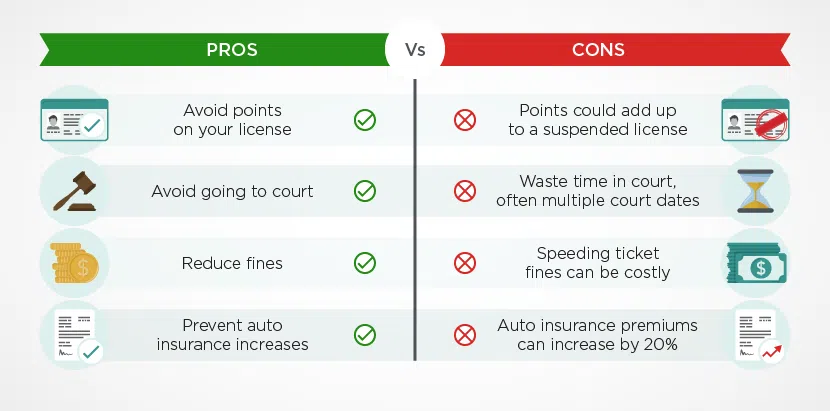
New York City’s TVB
There are courts that will not reduce speeding tickets or engage in a plea bargain or settlement of any kind. New York City sees a large volume of traffic on its roads and set up a special hearing office within the Department of Motor Vehicles to process traffic tickets. This office is known as the Traffic Violations Bureau, or “TVB” for short.
Speeding tickets issued in New York City should not be ignored. In fact, you will definitely want to seek legal advice because the TVB has stricter rules than most courts. It doesn’t allow plea bargains; it doesn’t require proof of guilt beyond a reasonable doubt; it limits the kind of evidence a driver can demand access to before the trial; and it allows the police to admit hearsay evidence.
Notice: Tickets for speeding in a work zone or school zone can cost twice as much as a regular speeding ticket.
How to Read a New York Speeding Ticket
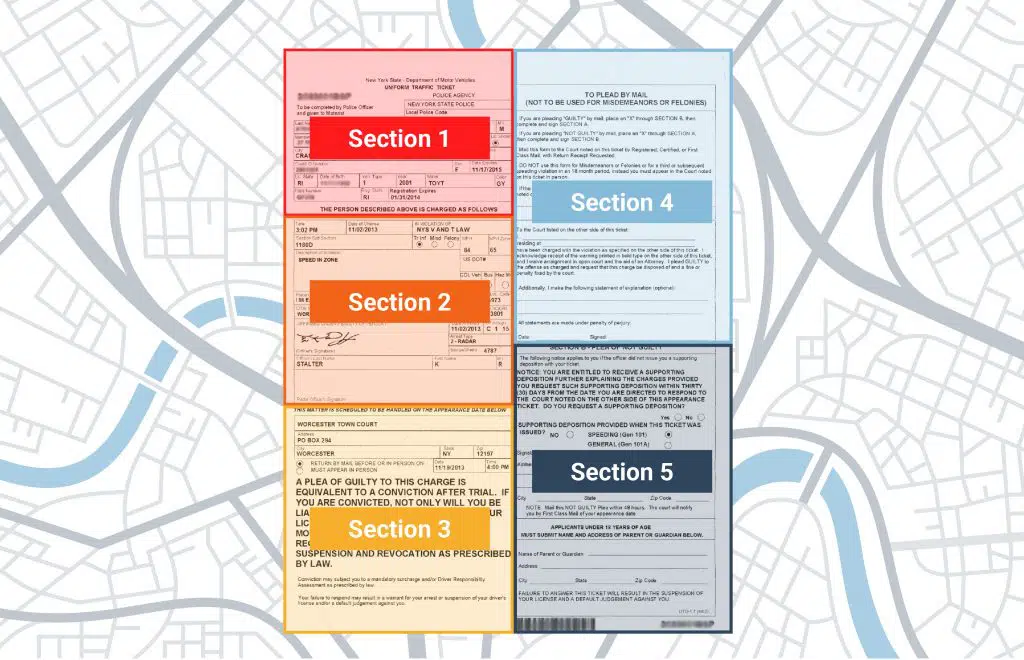
These boxes display numerous identifying data about the defendant including name, address and information about the car being driven at the time of the stop. Note: If the officer made a minor mistake in the section (e.g. the officer wrote down the wrong color of the car) the case will NOT be dismissed.
The “Section Sub Section” box indicates which section of the law the defendant is being accused of violating. Below is a list of common New York traffic violations as well as the New York Vehicle & Traffic Law sections they fall under, the amount of points (if any) and the maximum fines and NYS surcharges attached to them. It also lists the location and officer’s information.
This particular Section shows the name of the court and its address, along with a date and time for a response, either by postal mail or in person.
Drivers choosing to plead “Guilty” to the charges should fill out this Section and mail it to the address of the court mentioned in Section 3.
Important Note: Many people think that if they plead guilty “with an explanation,” the court may consider their explanation and find them not guilty. This is a big misunderstanding. Anyone who fills out this portion of the ticket and mails it in will be convicted of the offense.
The only way to challenge the charges or get the charges reduced is to plead “not guilty” (see next Section). It is also a common belief that a person should plead “Guilty” if he or she knows that he was, in fact, guilty. Keep two things in mind: Entering an initial plea of “Not Guilty” does not mean there is no going back. On the contrary, it preserves the right to a plea bargain or trial. A person can always change his/her plea to “Guilty” later, and in most cases where a plea bargain is offered, he/she will plead guilty at some point, but to a less severe offense than the one initially charged.
Those who choose to plead “Not Guilty” must complete section 5. The “Not Guilty” section features a spot to request a supporting deposition. A supporting deposition is a written, sworn statement detailing the traffic violation, signed by the law enforcement officer who issued the ticket. Remember, everyone has the constitutional right to plead “Not Guilty.” A person can always change the plea later, and if an acceptable plea bargain is offered, he/she will ultimately plead guilty to the reduced charge.
For more information, drivers should download the How to Read a Speeding Ticket PDF.
How to Fight a New York Speeding Ticket
It is not advisable that a driver attempt to fight a speeding ticket on their own. Most prosecutors, judges and even officers are adept at questioning individuals so as to extract information that can result in a conviction. Even a person who is truly honest and genuinely innocent can accidentally say something that can result in being convicted of a traffic offense. By contrast, a skilled and experienced traffic ticket attorney will know how to navigate such questions and present the driver’s case in the best possible light so as to mitigate or avoid a conviction.

Another reason drivers should consider hiring an attorney is that traffic court is nothing like criminal court. In most criminal cases, the prosecution must prove a defendant understood what they did was wrong or had deliberately intended to commit the crime. However, this does not apply in traffic court, which operates under the rule of strict liability in most cases. Strict liability removes the mental state component from the equation. In other words, a driver can be convicted of speeding regardless of whether or not he/she knew they were exceeding the limit or intended to speed.
As such, a driver who insists they were not aware that the speed limit was only 55 miles per hour on the New York Thruway will not get out of a ticket. All that matters is whether or not it can be proven the driver was speeding. Similarly, there are no legally permissible justifications for speeding. For example, telling an officer that they really need to use the restroom, are having a baby, or any other excuse will not likely sway an officer or judge.
To understand the tactics needed and challenges faced in defeating a New York speeding ticket, one must turn to existing case law.
Case Law Analysis
New York case law reveals several crucial points to bear in mind as a driver.
First and foremost, a New York speeding ticket issued by a police officer who does not use a mechanical device like radar, and, instead, estimates it will still be sufficient to convict a driver for speeding. (See People v. Olsen, 22 NY 2d 230.)
The court in Olsen explained its rationale by saying:
“The rule is well settled in this State that opinion evidence with regard to the speed of moving vehicles is admissible provided that the witness who testifies first shows some experience in observing the rate of speed of moving objects or some other satisfactory reason or basis for his opinion.” (See People v. Olsen, 22 NY 2d 230.)
Similarly, in People v. Dusing, the court summed up in one cogent statement a governing rule that applies to all drivers ticketed for speeding in New York. The court concluded,
“The sum of the combined Magri, Heyser and Marsellus holdings is: first, that a reading from an untested speedometer or radar device is admissible but is not[,] without more[,] sufficient for a speeding conviction; and, second, that the resulting deficiency in proof can be supplied by the testimony of qualified observers.” (See People v. Dusing 5 NY 2d 126.)
It is worth noting that the Dusing court said “observers,” not “officers.” This means a police officer does not have to be the one to testify against the driver. In most cases, if the prosecution finds any “qualified observer” (e.g. another driver on the road who saw the defendant), that person combined with the radar evidence will be enough to convict a person of speeding.
Second of all, the fact that a speeding ticket is not a crime appears to cut both ways. Since speeding is usually not a crime, it does not carry with it the severity of most criminal penalties. However, since it is not usually a crime, “not all the constitutional protections normally afforded to criminal defendants need be applied to those charged with such a minor offense.” (See People v. Phinney, 22 NY 2d 288.)
Lastly, a driver might be in for a rude awakening if he expects to be able to compel the TVB to turn over pertinent documents to him. Although the TVB has the right to do so, New York law does not require it to do so.
In Matter of Miller v. Schwartz, an attorney requested certain documents and information regarding the type of radar that was used to pull over his client. The TVB denied the request and explained that traditional discovery rules do not apply in the TVB. The lawyer took the case to court to compel the TVB to give him the documents. However, the court sided with the TVB and denied the attorney’s request.
The Schwartz court based its conclusion on the well-settled rule that there is no general constitutional right to discovery in criminal cases or administrative proceedings (See Weatherford v Bursey, 429 US 545 and National Labor Relations Bd. v Interboro Contrs., 432 F.2d 854, cert. denied 402 US 915).
Ultimately, this ruling reveals how difficult it can be—even for an attorney—to navigate through the complicated TVB system. If nothing else, this case shows drivers who get TVB tickets the importance of hiring an experienced traffic ticket attorney familiar with the TVB’s rules and procedures.
Read More: Ten Winning Arguments to Use in Fighting a New York Speeding Ticket
Key Takeaways
- For a radar gun reading to be used to convict someone of speeding, the gun must be certified to be in good working order following specific procedures.
- If a radar gun is found to be untested, the gun’s reading can still be used if the officer or another “qualified witness” testifies that the driver was observed speeding.
- That qualified witness does not need to be a police officer.
- With or without a radar gun, a police officer’s visual estimate of a driver’s speed is enough to justify a speeding ticket (and potentially convict the driver).
How a New York Speeding Ticket Impacts Out-of-State Drivers
It is a common misconception that drivers from other states can and should ignore a New York speeding ticket. The reality is that New York State can suspend someone’s right to drive within its borders for failing to respond to or pay a speeding ticket issued here. Likewise, a driver who pays a New York speeding ticket can still face the consequences of points, insurance increases and hefty fines associated with a conviction. New York will also inform the home state of a driver of any convictions, which means those convictions are very likely to end up on a person’s driving record.
Important: A driver from another state who fails to pay (or fight) a New York speeding ticket could have his or her license suspended.
How each state handles a New York speeding ticket varies. Here are some examples:
- New Jersey- A driver licensed in New Jersey who is ticketed for speeding in New York faces two points on their license for each conviction. These points are assessed by the New Jersey Motor Vehicle Commission. The points count towards suspension of both New York and New Jersey driving privileges. Read More
- Connecticut- Drivers from Connecticut should be aware that New York does not allow drivers to plead nolo contendere (i.e. no contest) to speeding tickets. As such, the only way to avoid getting points for a New York speeding ticket is to get it dismissed or plea it down to a no-point violation. Read More
- Pennsylvania- In the Keystone State, driving 1-5 mph over the limit is not considered speeding. However, in New York it is a three-point offense with a maximum fine of $150 (+ the surcharge). Pennsylvania drivers will be happy to know that their home state will not assess points for out-of-state violations; however, their auto insurance companies may still raise their rates as though the violation occurred at home. Read More
- Other states- Drivers licensed in any of the other 50 states and Washington, D.C. can find more information about New York speeding tickets by visiting our out-of-state license page.
Common Questions About New York Speeding Tickets
Yes. New York participates in the Driver’s License Compact, an interstate agreement that allows most states to share information about speeding and other traffic convictions that occur in their state. An out-of-state driver who pays or is convicted in court of speeding in NY will most likely see that conviction listed on their driving record which could lead to license suspension and other consequences.
Points don't come off your license. What changes is whether they still count against you.
New York counts points from the date of the ticket, not the date you were convicted. Since February 16, 2026, points count toward a license suspension for 24 months from that date. Before that, it was 18 months.
A second clock applies to the Driver Responsibility Assessment (DRA), and it still uses 18 months. If you get 6 or more points in 18 months, you owe the DMV an extra fee, paid over 3 years.
When a clock runs out, those points stop counting toward that penalty. The conviction still stays on your driving record for years, and your insurance company can still see it and raise your rates.
A DMV-approved defensive driving course won't erase points either. It can lower your point total by up to 4 points when the DMV decides whether to suspend your license. It doesn't reduce a DRA fee.
A ticket from 20 months ago used to be behind you. Now it can still add up with a new one. Before you pay any ticket, check your record on MyDMV to see which points are still counting.
There is no single answer to this as it depends on so many factors, including past driving history, age, even the level of income and education. Some studies have found that a single speeding ticket can increase rates by 30% or more.
Technically, there is no statute of limitations for a speeding ticket in New York. Drivers should not be fooled into thinking they can ignore a New York speeding ticket hoping it will “expire.” Once a speeding ticket is handed to the driver, the clock is ticking for the driver to respond with a “Guilty” or “Not Guilty” plea. Failing to respond to a New York speeding ticket will result in an immediate driver’s license suspension.
A driver should always plead not guilty to a speeding ticket. Pleading guilty is not advisable because:
- It can lead to higher fines and/or insurance rates.
- It can add points to a driver’s record, and accumulating enough points over time can lead to license suspensions.
- It can also negatively impact a driver’s case if they try to plead not guilty to a speeding ticket in the future. This is because points can be accessed on the driver’s record by the court.
No. If a driver pleads guilty, they could pay the fine without going to court, unless their court information on their speeding ticket states that they are required to go to court. However, pleading guilty can lead to a worse verdict, such as expensive fines or points on the driver’s license. It is advised that driver’s who receive a speeding ticket plead not guilty and go to court, although their attorney may be able to fight for them in court on their behalf. An attorney from Rosenblum Law can assist a driver in the court process and fight for a favorable outcome to avoid harsh consequences.
No. Speed cameras on the road only capture vehicles, not the drivers behind them. Therefore, New York will not add points to a driver’s record for violations captured by a camera.
Yes. Speeding tickets and other traffic violations in New York can be accessed by accessing the online service called MyDMV. MYDMV is run by the New York State Department of Motor Vehicles (DMV) and requires users to create an account and verify their identity to view details about their record.
After a driver pleads not guilty to a speeding ticket, they will attend court and have the opportunity to plead down, or negotiate, their traffic violation. In order to optimize the outcome of a driver’s plea, drivers should hire an attorney to negotiate the offense down to a non-moving violation or a lesser-point ticket.
Traffic tickets may be dismissed in New York, allowing driver’s to avoid fines, points, or rising insurance rates. A traffic ticket can be dismissed when:
- A driver pleads not guilty and attends trial. An experienced attorney can help a driver win their case by arguing that the police officer’s testimony does not prove guilt.
Other Types of Speeding Tickets
- Speeding in a Work Zone
- Speeding in a School Zone
- Racing Tickets
- Speed Not Reasonable and Prudent
- Uber & Lyft Drivers
Data on New York Speeding Tickets
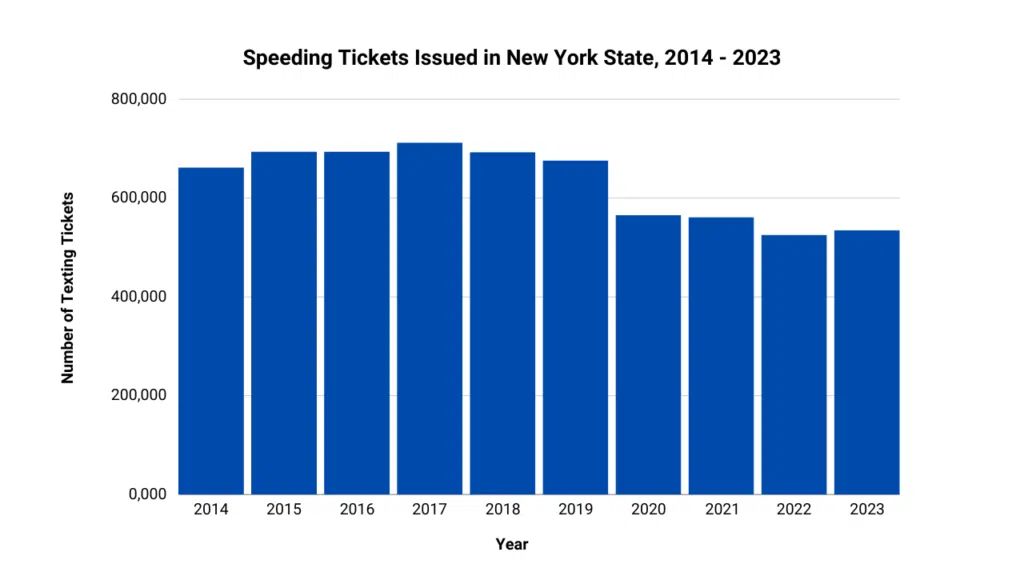
According to the Institute for Traffic Safety Management & Research, the number of speeding tickets in New York State has seen a decline from 2014 to 2023, with significant fluctuations due to factors like the pandemic and potential shifts in law enforcement tactics. In 2023, there was a slight increase in the number of speeding tickets issued (535,081 tickets), which suggests a partial return to pre-pandemic patterns. However, it is still far below the peak years of 2016 (712,370 tickets) and 2017 (693,051 tickets).
Speeding-related accidents are a leading cause of injuries and fatalities in New York during 2023. It contributed to nearly 30% of accidents that resulted in injuries. Efforts to reduce speeding through law enforcement and public awareness campaigns are crucial in minimizing the risk of these preventable accidents and protecting lives.
March and August 2023 showed the highest number of speeding tickets issued by month, with police handing out 48,312 and 50,763 speeding tickets, respectively. During the last few months of the year, the number of speeding tickets dropped off compared to the earlier months: only 42,477 speeding tickets were given out in November and 35,681 in December.
New York State Police issued the highest number of speeding tickets, amounting to 58% of the total tickets. On the other hand, local law enforcement agencies also ticketed drivers for speeding, such as the NYPD (14.8%), county police (8.3%), and other agencies (18.9%).
Westchester County took the lead as the county with the most speeding tickets issued (38,311 tickets), far outpacing the other counties. Erie and Suffolk followed with 33,238 and 32,695 tickets, respectively. Queens, a borough of New York City, has 26,078 tickets, while Orange County (22,734 tickets) appears to have a lower frequency of speeding violations compared to the rest of the counties.
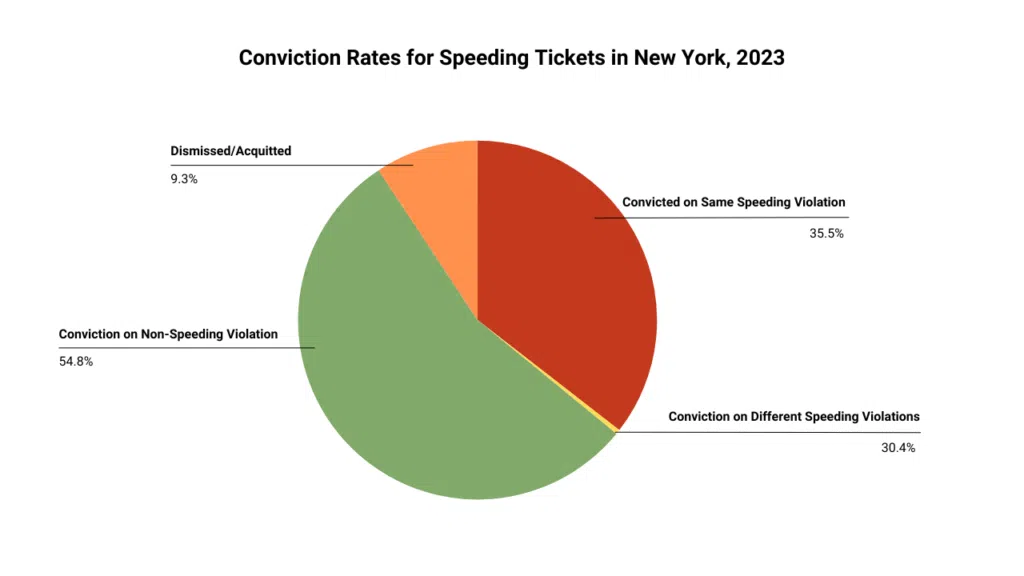
Accumulating too many points on your driving record can result in license suspension or revocation. This can impact your ability to drive to work or school, as well as other daily activities. Additionally, having points on your record can result in increased car insurance premiums, making it more expensive to operate your vehicle. That’s why it's important for drivers to resolve their speeding tickets quickly and with the least impact on their lives as possible.
More Resources
- Supporting Depositions and New York Traffic Tickets: What You Need to Know
- Speeding tickets and Pretrial Conference
- A Guide to Handling Your First NY Speeding Ticket
- Speeding With a Junior License or Restricted License in New York
- Second or Third Speeding Ticket in New York
- How To Fight A NY Speeding Ticket – A Comprehensive Guide
- Speeding Tickets in Manhattan (New York County), NY
- Driving Too Slow
- Out-Of-State Traffic Ticket With NY License
- Do NY Speeding Tickets Show Up on a Background Check?
- Speeding Tickets in NY With NJ license
- NY Speeding Tickets and Pretrial Conference
- Can I Go to Jail for Speeding in New York?