

Page Content
Reckless driving in New York is a crime, not just a traffic ticket. It is a misdemeanor under Vehicle and Traffic Law (VTL) 1212.
A first conviction can mean up to 30 days in jail, a fine of up to $300 plus a surcharge, and 5 points on your license. It also leaves a criminal record that never goes away, and it can raise your insurance and put your license at risk.
Below are the full penalties, what counts as reckless driving, and how these charges are usually fought.
Reckless Driving Penalties in New York
The penalties go up with each conviction within 18 months.
| Conviction (within 18 months) | Fine | State surcharge | Driver Responsibility Assessment (DRA) | Points | Max jail |
|---|---|---|---|---|---|
| First | $100–$300 | $88 or $93 | None from this ticket alone | 5 | 30 days |
| Second | $100–$525 | $88 or $93 | $600 (10 points) | 5 more (10 total) | 90 days |
| Third | $100–$1,125 | $88 or $93 | $975 (15 points) | 5 more (15 total) | 180 days |
The surcharge depends on where the ticket was issued. The DRA is a separate fee paid to the DMV over three years, on top of the fine.
Important: Reckless driving is more than a traffic ticket; it is a misdemeanor criminal offense and can result in jail time and a criminal record.

Fight Your Reckless Driving Ticket
Call Now - We've Fought Over 100,000 Traffic Violations
Quick, free, and no obligation.
Other consequences
A permanent criminal record. Reckless driving is a misdemeanor. A conviction stays on your criminal record for life. It can show up on background checks for jobs, housing, college admissions, and financial aid. For non-citizens, it may also affect immigration status.
The DRA fee. If you get 6 or more points within 18 months, the DMV charges a DRA of $300 plus $75 for each point over 6. Reckless driving is worth 5 points, so one more moving violation is usually enough to trigger it.
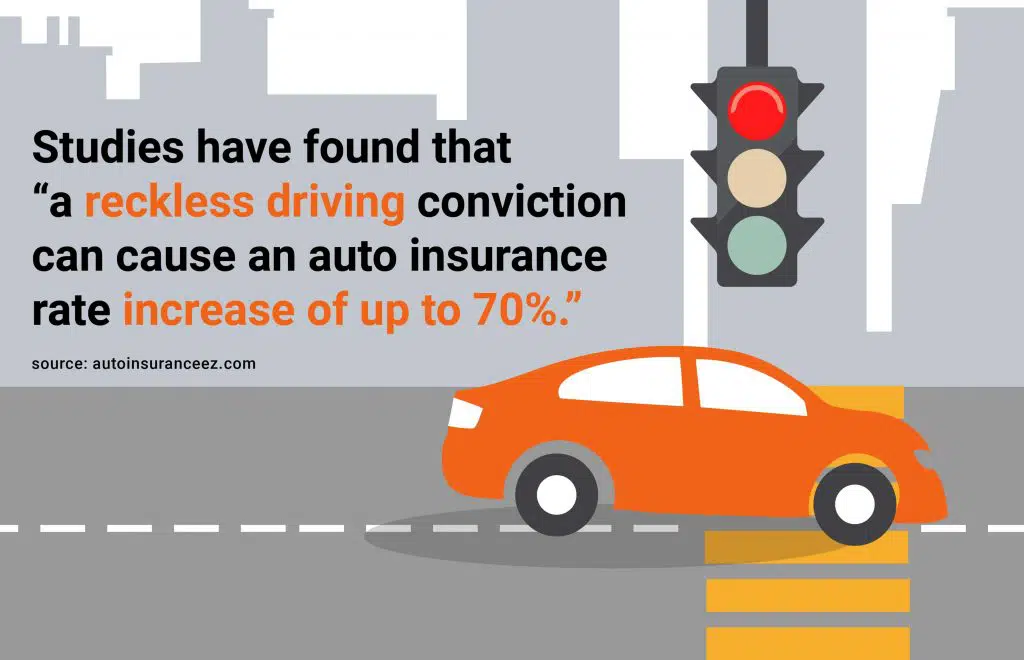
Higher insurance. Most moving violations raise car insurance rates. Reckless driving can raise them sharply. Because it is a crime, it may also affect life and homeowner's insurance rates.
Possible license suspension. A judge can suspend your license as part of the sentence. The DMV will also suspend your license if you reach 11 points within 24 months. With a 5-point reckless driving conviction, that can happen with one 6-point speeding ticket (21–30 mph over the limit) or two 3-point tickets, such as red lights.
What Counts as Reckless Driving in New York?
Under VTL 1212, you can be convicted of reckless driving if you drive in a way that:
- "unreasonably interferes" with other people's use of the road, or
- "unreasonably endangers" other drivers, cyclists, or pedestrians.
There is no set speed or single action that makes driving reckless. Police have wide discretion, which means they decide on the spot whether your driving fits.
To win in court, the prosecutor must prove more than a mistake. They must show you drove with a clear disregard for other people's safety, in a way a reasonable driver would not.
In practice, breaking one traffic rule is usually not enough. Courts look for something extra, such as high speed combined with weaving, or a crash. Lawyers call these "aggravating acts."
Real Examples: What Courts Have Said
The difference between a regular ticket and reckless driving usually comes down to two things: how many risky actions were combined, and how dangerous they were.
Usually counts as reckless driving
| What the driver did | Case |
|---|---|
| Drove off the road at high speed near pedestrians and made no effort to slow down | People v. Goldblatt, 98 A.D.3d 817 |
| Drove through a police barricade | People v. Patterson, 23 Misc.2d 182 |
| Drove onto an exit ramp, made a U-turn across three lanes, and hit another car | People v. McGrantham, 12 N.Y.3d 892 |
| Crossed the center line at high speed and crashed into an oncoming car | People v. Armlin, 6 N.Y.2d 231 |
| Used drugs, swerved into oncoming traffic, and caused a fatal crash | People v. Bohacek, 95 A.D.3d 1592 |
| Swerved between lanes and hit another car | People v. Van De Cruze, 2012 NY Slip Op 51378 |
Usually does not count on its own
| What the driver did | Case |
|---|---|
| Drove 5–15 mph over the limit and ran a stop sign and two red lights, with no evidence anyone was affected | People v. Bulgin (Sup. Ct. Bronx County, 2010) |
| Committed several traffic violations, with no proof anyone was endangered or blocked | People v. Khurshudyan (App. Term, 2012) |
| Ran a single stop sign | People v. Garo (Broome Co. Ct., 1955) |
| Drove 45–50 mph and made a U-turn on an open highway | People v. Korytowski (Schenectady Co. Ct., 1958) |
The pattern: one broken rule is usually a regular ticket. Several risky actions together, or a crash, can turn it into a crime.
Learn how we can reduce reckless driving ticket fines and points. Call us for a free consult: 888-883-5529
How Reckless Driving Charges Are Fought
Reckless driving cases are harder to fight than regular tickets. Because it is a criminal charge, you usually have to appear in court. Prosecutors and judges also tend to be less flexible when negotiating.
Still, the prosecutor has to prove the charge. These are the defenses lawyers raise most often.
There was nothing beyond a single traffic violation. Courts require "additional aggravating acts or circumstances beyond a single violation of a rule of the road" (People v. Goldblatt). If you only sped or made a bad lane change, with no erratic driving, a lawyer may argue the charge should be dismissed or lowered to a regular ticket, such as speeding or an improper turn.
The driving was reasonable. A lawyer can argue, using the exact words of the law, that your driving did not endanger anyone or block anyone's use of the road, given the conditions at the time.
Problems with the stop or the evidence. If there is solid proof that the officer acted improperly, it may not get the charge dismissed. But it can affect how the case is negotiated or how the court views it.
Every case is different. Whether any of these defenses fits depends on the facts of your stop.
According to highya.com, your insurance rate may increase by as much as 76% as a result of your reckless driving conviction.
Reckless Driving Tickets in NYC
Most traffic tickets in New York City go to the Traffic Violations Bureau (TVB). Reckless driving does not. Because it is a misdemeanor, criminal court handles it, where the process and stakes are different.
Did you
know?


Kent Ng
Out-of-State Drivers
Having a license from another state does not let you ignore a New York ticket. New York shares driver information with most other states, so a reckless driving conviction usually follows you home.
Because reckless driving is a crime, it can also appear on a criminal background check, no matter where you live.
Should You Hire a Lawyer for a Reckless Driving Ticket?
eckless driving is one of the most serious tickets a New York driver can get. It carries possible jail time, high fines, 5 points, and a permanent criminal record.
An experienced New York traffic attorney can review the evidence and look for ways to get the charge reduced to a regular traffic ticket, such as speeding or an improper turn. Results depend on the facts of each case.
Talk to us about your ticket. We've fought over 100,000 traffic tickets. Consultations are free and quick, with no obligation.
Notice: If a person can provide evidence that their driving behavior was justified—such as in the case of attempting to avoid a road obstruction or person or animal—then he or she may be able to beat a reckless driving charge.
Case Law Analysis
The case law in New York reveals a very interesting insight into convictions for VTL 1212. Usually, engaging in multiple traffic violations will amount to reckless driving (see People v Grogan, 260 NY 138).
Additionally, if those infractions would be considered dangerous to the average individual, a judge will likely find the driver guilty (see People v Lamphear, 35 AD2d 305).
For example, in People v. Bohacek, 95 AD 3d 1592, a woman’s car crossed over into the oncoming lane of traffic and collided with another vehicle. If the story ended there, he would have been dealing with a run-of-the-mill negligence case, not reckless driving.
However, the driver of the other vehicle was killed instantly, and a blood test revealed that the woman who swerved into the other lane was on drugs at the time. With these facts on the table, due to the combined unreasonableness of: 1) driving while on drugs, 2) swerving into oncoming traffic, and 3) being the cause of a fatal car crash, there is no doubt why the judge ruled that this amounted to reckless driving.
Likewise, just swerving in and out of lanes will not constitute reckless driving. However, if the driver hits a car while swerving, it usually will (see People v. Van De Cruze, 2012 NY Slip Op 51378).
The difference between getting slapped with a routine traffic ticket and one for reckless driving appears to be in the compounded nature of the conduct as well as how dangerous it ultimately was. Download a free copy of our Reckless Driving ebook.
Out-of-State Drivers
Having a license from another state does not let you ignore a New York ticket. New York shares driver information with most other states, so a reckless driving conviction usually follows you home.
Because reckless driving is a crime, it can also appear on a criminal background check, no matter where you live.
Key Takeaways
- Reckless driving is often charged when a driver commits multiple traffic violations.
- However, a violation or the combination of violations must be seen to have endangered the welfare of others, be they drivers, pedestrians, cyclists, etc.
- Causing an auto accident does not necessarily mean someone will be charged with reckless driving.
- The compound nature of multiple decisions/actions is what ultimately determines whether someone is charged with reckless driving.
Common Questions
Most moving violations will impact a driver's insurance premiums. A reckless driving conviction can increase rates by as much as 73%. Because reckless driving is classified as a criminal offense, it can also lead to higher premiums for life insurance and homeowner's insurance.
Reckless driving penalties in NY are as follows:
First Offense: Maximum fine of $300, five points added to your license, and up to 30 days in jail.
Second Offense: Maximum fine of $525, an additional 5 points added to your license, and up to 90 days in jail.
Third Offense: Maximum fine of $1,125, an additional 5 points added to your license, and up to 180 days in jail.
In addition, Drivers convicted of six or more points worth of violations in 18-months will be assessed a Driver Responsibility Assessment fee (DRA) of $300 plus an additional $75 for each point after six.
In New York City, a driver can be convicted of reckless driving if they operate a vehicle in a manner that "unreasonably interferes" with the use of the public highway or "unreasonably endangers" other drivers, cyclists, or pedestrians. Law enforcement officers have considerable discretion in determining what constitutes reckless driving. For a conviction, the prosecutor must prove that the driver behaved with a reckless disregard for the safety of others, acting in a manner that a reasonable person would not.
Yes. For instance, if the defense attorney can demonstrate that the driver merely committed a speeding or lane-change violation without any erratic or unusual behavior, the reckless driving charge is likely to be dismissed or significantly reduced.
Two driving convictions within three years will result in a 60-day suspension of the driver’s CDL license. An additional violation within the same three years will result in a 120-day suspension.
Additional penalties for two convictions within 18 months could include up to a $525 fine, 90 days in jail, a large vehicle insurance premium increase, and five additional points on the driver’s record. A third conviction in that timeframe may include up to a $1,125 fine, 180 days in jail, a further insurance premium increase, and five additional driving record points.
There is no formal speed that is considered to be reckless per se. However, excess speed in combination with any number of other factors can be grounds for a reckless driving charge. Generally speaking, an officer will issue a ticket for reckless driving if a driver is acting in a way that is considered unreasonable and either endangers others or prohibits use of the roadway.
No. Reckless driving is classified as a misdemeanor in New York. While less serious than a felony, a misdemeanor conviction can still result in jail time, heavy fines, and a permanent criminal record.
A reckless driving conviction will stay on a New York driving record for three years. However, the misdemeanor conviction will remain on one’s criminal record forever.