
If you got a careless driving ticket in New Jersey, you're probably worried about points, fines, and your insurance. That's normal. Let's take it one step at a time.
A ticket is the officer's accusation. It is not proof. On this page, I'll explain what the charge means, what pleading guilty can cost you, and why you should talk to a lawyer before you plead guilty.
What is careless driving in New Jersey?
Careless driving means driving without enough care in a way that puts people or property at risk, or is likely to (N.J.S.A. 39:4-97). The law uses the words "without due caution and circumspection." In plain words, the State says you weren't careful enough, and that it put someone or something in danger.
Officers often write this ticket after a crash. They may also write it along with another ticket, like an unsafe lane change. The law is broad, so it gives officers a lot of room. That's also why the details of your case matter so much.
What happens if I plead guilty to careless driving?
Pleading guilty puts 2 points on your license and adds a fine and court costs. For some drivers, it can cost more than that.
| What you face | Careless driving (N.J.S.A. 39:4-97) |
|---|---|
| Points | 2 points on your NJ driving record |
| Fine | $50 to $200 (N.J.S.A. 39:4-104) |
| Court costs | Up to $33, on top of the fine (N.J.S.A. 22A:3-4) |
| Jail | Up to 15 days. This is rare, and the judge must explain the reasons |
| MVC surcharge | Only if you reach 6 or more points in 3 years: $150 a year for 3 years, plus $25 for each point over 6 |
| Insurance | Points on your record may raise your rates |
| Your license | After a crash with serious injury or death, the MVC may try to suspend your license in a separate case |
Two points alone won't suspend your license. But points add up with any other tickets on your record. In New Jersey, 12 or more points can lead to a license suspension.
Don't plead guilty before you talk to a lawyer. Call 888-883-5529 for a free consultation.

How is careless driving different from reckless or unsafe driving?
The biggest difference is the level of fault the State says you showed. Careless driving means you weren't careful enough. Reckless driving means you knew about a risk to others and ignored it.
| Charge | What the State says you did | Points | Fine (first offense) |
|---|---|---|---|
| Careless driving (39:4-97) | Drove without enough care, in a way likely to put people or property at risk | 2 | $50 to $200 |
| Reckless driving (39:4-96) | Drove with "willful or wanton disregard" for the safety of others | 5 | $50 to $200, or up to 60 days in jail |
| Unsafe driving (39:4-97.2) | Drove in an unsafe way likely to put people or property at risk | 0 for a first or second offense | $50 to $150, plus a $250 surcharge |
Unsafe driving often comes up as a lesser charge in a plea deal. It has no points the first two times. A third offense within 5 years carries points and a fine of $200 to $500.
What does the State have to prove?
You are presumed innocent. Careless driving is a "quasi-criminal" case, which means the State must prove it beyond a reasonable doubt. That's the same high standard used in criminal cases.
The State has to prove two things:
- You drove without enough care.
- Your driving put people or property at risk, or was likely to.
A crash alone is not enough. In State v. Wenzel, a New Jersey appeals court threw out a careless driving conviction. The State had shown that a crash happened, but not how the driver was driving. This means the prosecutor needs real proof of what you did, like a witness or the officer's own observations.
That proof can come from more than one place. If a witness saw what happened, or you told the officer how the crash happened, that may be enough for the State. This is why it helps to have a lawyer look at the evidence before you decide anything.
How can a lawyer help with a careless driving ticket?
Maybe you know you made a mistake on the road. That doesn't mean you have to accept every point and penalty on the ticket. Everyone has the right to make the State prove its case.
When my team and I review a careless driving ticket, we look at:
- Who saw it. If the officer arrived after a crash, we check whether anyone actually saw how you were driving.
- The ticket and the reports. We look for mistakes in the ticket, the crash report, or the officer's notes.
- What the State can use. We check whether the evidence can be used in court at all.
- A possible plea deal. In New Jersey municipal court, the prosecutor may offer a deal to plead to a lesser charge. That could be unsafe driving, which has zero points for a first or second offense. The judge must approve any deal.
These options depend on the facts of your case. No lawyer can promise a result. But a lawyer can tell you what you're facing and what your choices are before you decide.
Do you have to go to court? You may. In New Jersey, a lawyer can appear for you without you there only if the court approves a hardship request.
My team has handled 100,000+ traffic tickets. Before you plead guilty, call us at 888-883-5529.
Have An NJ Traffic Ticket?
Call Now - We've Fought Over 100,000 Traffic Violations
Quick, free, and no obligation.
What if I got a careless driving ticket after a car accident?
A crash raises the stakes in three ways. Here's what to know before your court date.
Your guilty plea can be used in a lawsuit
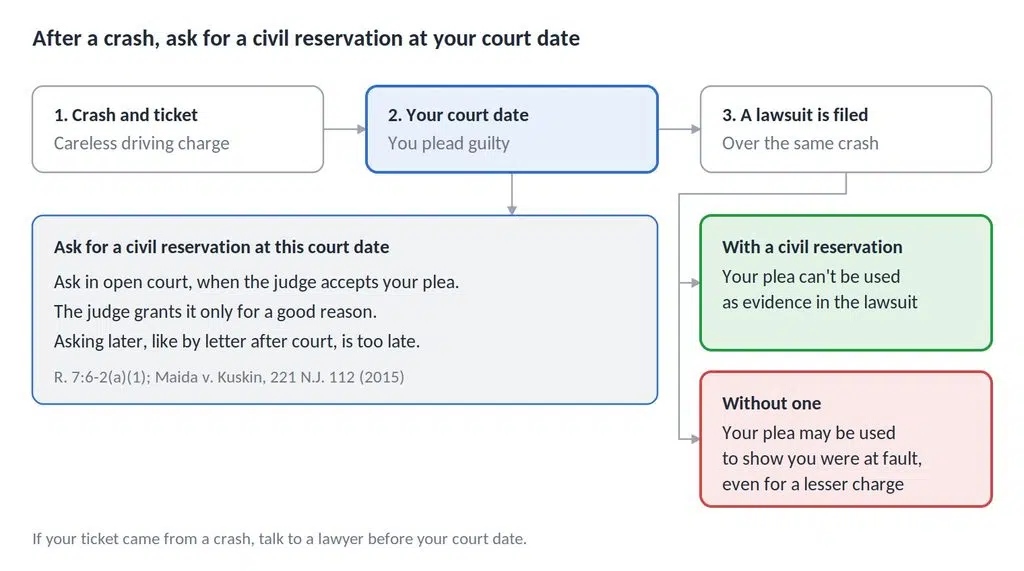
If someone sues you over the crash, they may try to use your guilty plea to show the crash was your fault. That's true even if you plead guilty to a lesser charge.
You can ask the judge for a civil reservation. That's a court order that keeps your guilty plea from being used as evidence in a civil lawsuit (R. 7:6-2(a)(1)). The judge grants it only for a good reason, and you must ask for it at the right time.
In Maida v. Kuskin, 221 N.J. 112 (2015), New Jersey's highest court said the request must be made in open court, at the same time the judge accepts your plea. In that case, the driver's lawyer asked for it by letter after court. The Court said that was too late. This means you need to plan for it before you walk into court.
The judge has more options
Careless driving can carry up to 15 days in jail, but that's rare. In State v. Palma, New Jersey's highest court set rules for when a judge may give jail time or suspend a license for careless driving. The judge must weigh things that can make the penalty worse or lighter and explain the reasons.
The MVC may act on your license
After a crash that causes death or serious injury, the MVC can try to suspend your license if it finds a traffic violation helped cause the crash (N.J.S.A. 39:5-30). This is a separate case from your court ticket, with its own hearing.
Special situations
Commercial drivers (CDL). A conviction can go on your commercial record even if you were driving your own car. Federal rules can disqualify a CDL holder after two or more serious traffic violations in 3 years (49 CFR 383.51). Talk to a lawyer before you plead, because your job may depend on it.
New drivers (probationary or GDL license). New Jersey has extra rules for newer drivers. A ticket during the probationary period may mean a required driver program or a longer probationary period.
Out-of-state drivers. If you have a license from another state, New Jersey usually reports the conviction to your home state. What happens next depends on that state's rules. If you have a New York license, see our page for New Jersey tickets and New York drivers.
What should I do next?
- Don't plead guilty yet.
- Find your court date and the court's name on the ticket.
- Write down what happened while you still remember it. Keep any photos, the other driver's information, and the police report number.
- Call 888-883-5529 for a free consultation.
Frequently asked questions
How many points is careless driving in NJ?
Careless driving (N.J.S.A. 39:4-97) puts 2 points on your New Jersey driving record. Points add up with any other tickets on your record. That's why it's worth knowing your options before you plead guilty.
What is the fine for careless driving in NJ?
The fine is $50 to $200, plus up to $33 in court costs. A judge can also order up to 15 days in jail, but that's rare. If your total points reach 6 or more in 3 years, the MVC adds a yearly surcharge.
What is the difference between careless and reckless driving in NJ?
Careless driving means driving without enough care in a way likely to put people or property at risk (N.J.S.A. 39:4-97). Reckless driving means driving with "willful or wanton disregard" for others' safety (N.J.S.A. 39:4-96). Careless driving carries 2 points. Reckless driving carries 5 points.
Can careless driving be reduced to unsafe driving in NJ?
Sometimes. In NJ municipal court, the prosecutor may offer a deal to plead to unsafe driving (N.J.S.A. 39:4-97.2), and the judge must approve it. Unsafe driving has no points for a first or second offense. It does have its own fine and a $250 surcharge.
Will a careless driving ticket raise my insurance?
It may. Insurance companies can look at the points and convictions on your record when they set your rates. A lawyer may be able to help you avoid points, depending on your case.
Is it worth fighting a careless driving ticket in New Jersey?
It can be. A conviction adds 2 points, and points may raise your insurance rates. The State has to prove how your driving put people or property at risk, and a crash alone isn't enough. Before you plead guilty, talk to a lawyer.
Can a careless driving guilty plea be used against me after an accident in NJ?
It can, unless the judge grants a civil reservation. A civil reservation is a court order that keeps your guilty plea from being used as evidence in a civil lawsuit. You must ask for it in court when the judge accepts your plea, and the judge must find a good reason (R. 7:6-2(a)(1); Maida v. Kuskin, 221 N.J. 112 (2015)).
Do I have to go to court for a careless driving ticket in NJ?
You may. If the ticket says a court appearance is required, you must go. A lawyer can appear for you without you there only if the court approves a hardship request.
Talk to a lawyer before you plead guilty
A careless driving ticket is an accusation, not a conviction. You have the right to make the State prove its case, and to know your options first.
Call 888-883-5529 for a free consultation. It's free, and there's no obligation.