
Getting a cell phone or texting ticket in New York can be frustrating, especially if you only glanced at your phone for a second. You probably want to know what this ticket means for your license, your record, and your wallet.
This page explains New York’s two phone laws, what a guilty plea can mean for your record, and what courts look at. Before you plead guilty or pay the ticket, talk to a lawyer about your options.
Which phone law is on your ticket?
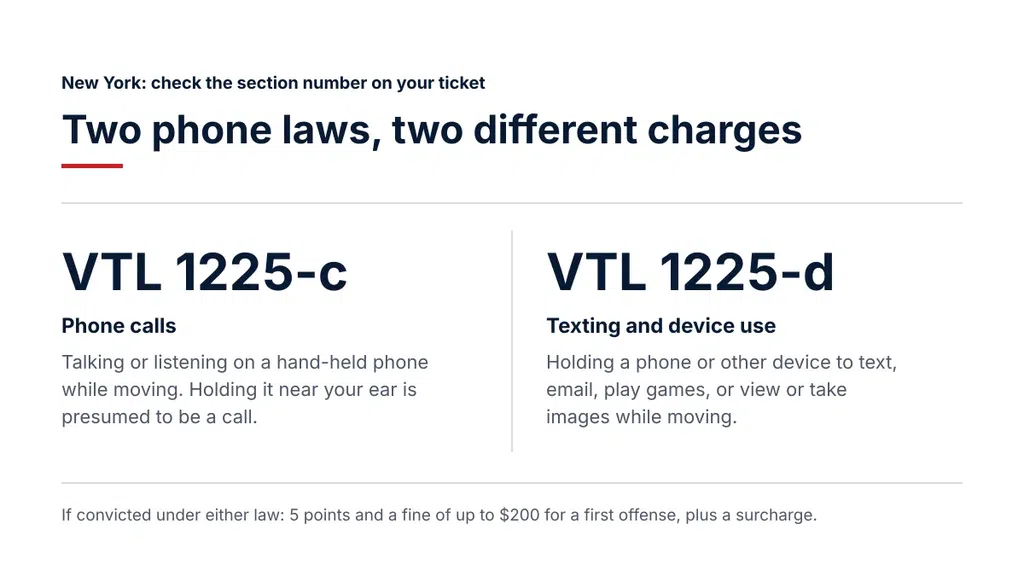
New York has two separate laws about phones and devices behind the wheel. The section number on your ticket tells you which one the officer charged. Each law covers different conduct, so the difference matters for your case.
| VTL 1225-c | VTL 1225-d | |
|---|---|---|
| What it covers | Talking or listening on a hand-held phone | Holding a phone or other portable electronic device to text, email, or go online to communicate, play games, or view or take images |
| When it applies to most drivers | While the vehicle is in motion on a public highway | While the vehicle is in motion |
| What the law presumes | Holding a phone to or near your ear while moving means you're on a call | Holding a device in a conspicuous manner while driving means you're using it |
| Can the presumption be challenged? | Yes, with evidence you weren't on a call | Yes, with evidence you weren't using the device |
VTL 1225-c covers phone calls. The law bars driving on a public highway while using a mobile phone "to engage in a call" while the vehicle is in motion (VTL 1225-c). A call means talking into or listening on a hand-held phone. Holding a phone only to turn it on or off, or to start one of its functions, is not a call under this law.
VTL 1225-d covers texting and other device use. This law bars using any portable electronic device while the vehicle is in motion (VTL 1225-d). A portable electronic device includes a hand-held phone, a personal digital assistant (PDA), a handheld device with mobile data access, a laptop, a pager, a two-way messaging device, an electronic game, a portable computing device, or any other electronic device used to write, send, receive, or read text for communication. "Using" means holding the device while viewing, taking, or sending images, or playing games. It also means holding it to communicate, such as opening a web page or writing, reading, viewing, or sending email, texts, instant messages, or other electronic data.
Because the two laws cover different acts, the state has to prove the conduct that fits the section written on your ticket. That's one of the first things a lawyer checks.
What a guilty plea can cost you
A ticket is an accusation, not a conviction. You are presumed innocent, and the state has to prove its case. But if you plead guilty, pay the ticket, or are found guilty under either law, the NY DMV lists these penalties:
| Penalty | First offense | Second offense within 18 months | Third or later offense within 18 months |
|---|---|---|---|
| Minimum fine | $50 | $50 | $50 |
| Maximum fine | $200 | $250 | $450 |
| DMV points | 5 | 5 | 5 |
| State surcharge and fee (most courts, including the TVB) | $88 | $88 | $88 |
| State surcharge and fee (town or village court) | $93 | $93 | $93 |
The judge sets the fine within these limits. The surcharge is an extra state fee added on top of the fine, under VTL 1809 and VTL 1809-e. In a town or village court, an extra $5 brings the total to $93.
The Driver Responsibility Assessment can add more. If you get 6 or more points for violations within 18 months, the DMV charges a separate fee of $100 a year for three years, plus $25 a year for each point over 6 (Driver Responsibility Assessment). For example, a 5-point phone ticket plus a 3-point speeding ticket within 18 months adds up to 8 points. That means $150 a year, or $450 over three years, on top of the fines and surcharges.
Points also count toward a suspension. Since February 16, 2026, the DMV looks back 24 months instead of 18 when it decides whether to take action against your license for repeated violations. One phone ticket puts 5 points on that clock, so you can learn how traffic ticket points in New York add up before you decide what to do.
Don't plead guilty before you talk to a lawyer. Call 888-883-5529 for a free consultation.
Junior and probationary drivers face a suspension
For newer drivers, a phone or texting conviction brings a license penalty that most adult drivers don't face. The DMV's graduated license rules and Driver's Manual describe these penalties:
- Junior license or permit: A first conviction suspends a Class DJ or MJ junior license or learner permit for 120 days.
- Probationary license: A first conviction suspends a probationary license for 120 days.
- A second conviction: A second conviction within six months after the license or permit is restored brings a revocation of at least one year. A revocation means your license is canceled, and you must reapply for a new one.
These penalties are set by law and come on top of the fines and 5 points. That's why the exact charge matters so much for a new driver, and why it helps to know the rules for junior license traffic tickets in New York before you respond.
Stricter rules for CDL drivers
If you were driving a commercial motor vehicle, New York's phone laws reach further. The first and last rules below come from both VTL 1225-c and VTL 1225-d. The middle two come from the call law, VTL 1225-c.
- Stopped still counts. You can't make a call or use a device while temporarily stopped because of traffic, a traffic light, or another short delay.
- Hands-free has a one-button limit. A phone isn't treated as hands-free if you dial or answer it by pressing more than one button.
- More counts as using a phone. Holding a phone to or near your ear, pressing more than one button, or reaching for it so you're no longer seated and belted in all count as using it.
- Pulling over is allowed. The laws don't apply when you're stopped at the side of the road, or off the road, where stopping is allowed.
Federal rules add another layer. Texting or using a hand-held phone while driving a commercial vehicle is a "serious traffic violation" under 49 CFR 383.51. Two serious traffic violations from separate incidents within three years can lead to a 60-day disqualification from driving a commercial vehicle, and three can lead to 120 days. Other serious violations, such as speeding 15 mph or more over the limit, count toward that total too.
When you can legally use your phone
The cell phone law has built-in exceptions. Under VTL 1225-c, the law doesn't apply to:
- Emergency calls. You can use the phone for the sole purpose of reaching an emergency operator, a hospital, a doctor's office, a health clinic, an ambulance service, a fire department, or a police department about an emergency.
- Officers and emergency workers on duty. Police officers, peace officers, firefighters, and drivers of authorized emergency vehicles are covered while doing their official duties.
- Hands-free phones. The law defines a hands-free phone as one you can use for a call without using either hand, even if you use a hand to turn it on or off or start a function.
The texting law, VTL 1225-d, has the same emergency and on-duty exceptions, but it has no hands-free exception. If you believe one of these exceptions applied, a lawyer can check whether the facts of your stop fit it.
TVB or local court: where your ticket goes
Where you got the ticket decides who hears your case. Non-criminal moving violation tickets issued in the five boroughs of New York City go to the DMV's Traffic Violations Bureau (TVB). Tickets issued elsewhere in the state go to the local court or traffic agency listed on the ticket.
At the TVB, the DMV says you can't be found guilty unless there is "clear and convincing evidence" that you committed the violation. You can testify, bring witnesses and evidence, and have a lawyer represent you at the hearing. The Traffic Violations Bureau (TVB) doesn't allow plea bargaining, so the case is decided on the charge itself.
Outside New York City, many local courts allow a deal to plead to a lesser charge, but that depends on the court, the prosecutor, and the facts. A lawyer can tell you what options your court allows.
NY Traffic Ticket?
Get Your FREE Consultation.
Call Us - We've Handled Over 100,000 Traffic Violations
Quick, free, and no obligation.
How a lawyer can help with a phone ticket
Maybe you know you picked up your phone. That doesn't mean you have to accept every point and penalty on the ticket. Here are some things a lawyer can look at:
- Whether the right law was charged. In People v. Fortini, 47 Misc 3d 1218(A), 2015 NY Slip Op 50661(U) (City Ct, Peekskill 2015), an officer saw a driver holding her phone toward or outside her driver's side window and believed she was using the camera. He charged her under VTL 1225-c, the call law. The court found that taking videos or photos isn't "engaging in a call" and dismissed the ticket, noting the proper charge would have been VTL 1225-d.
- Whether the presumption can be rebutted. Both laws let you offer evidence that you weren't on a call or using the device. Phone records or other proof may help show what you were actually doing.
- Whether the vehicle was moving. For most drivers, both laws apply only while the vehicle is in motion. A lawyer can look at the officer's notes for what they say about this.
- Whether an exception applies. An emergency call or a true hands-free setup can fall outside the cell phone law.
Fortini was decided by a city court, so other courts don't have to follow it, and a defense that worked in one case may not work in another. Still, it shows that the facts have to fit the law on the ticket. Before you plead guilty, find out what options you have in your court.
Out-of-state drivers with a New York ticket
If your license is from another state, a New York phone ticket still needs a response. If you don't answer a TVB ticket on time, the DMV says your license will be suspended. The DMV's Driver's Manual also says drivers from most other states will have their license suspended in their home state if they fail to answer a New York moving violation ticket.
Whether your home state adds points for a New York conviction depends on that state's own rules. Before you pay a New York ticket from out of state, check how it can affect your home record.
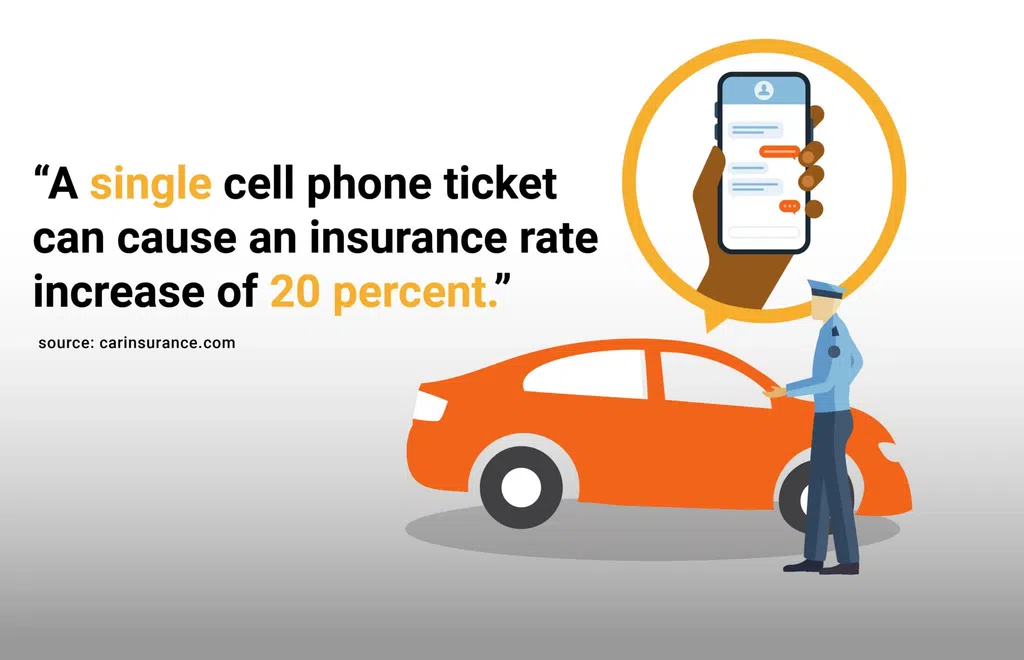
“Officers rarely give out texting or cell phone tickets unless they have clear visual evidence that the phone was in the hand of the driver. ” - Kent NG, NYPD (retired)
What should you do next?
What you do before your court date or hearing can shape your case. Both phone laws let you offer evidence that you weren’t on a call or using the device, and that evidence is easiest to gather while the details are still fresh. Here’s where to start:
- Don't plead guilty or pay yet. A conviction brings 5 points, a fine, and a surcharge.
- Check the section number. See whether the ticket says VTL 1225-c or VTL 1225-d.
- Note your deadline or court date. Missing it can lead to a suspension.
- Write down what happened. Note where your phone was, what you were doing with it, and whether the car was moving.
- Save any proof. Keep phone records for that time, dashcam video, and photos of any phone mount.
- Call for a free consultation. We can go over your ticket and your driving record with you.
Each of these steps ties back to what the state has to prove. The section number tells you which conduct the officer has to show, your notes and records can help challenge the presumption, and answering on time keeps a missed deadline from adding a suspension. A lawyer can then use what you’ve gathered to look at the options in your court.
FAQs
Is talking on speakerphone legal while driving?
Only if the phone is truly hands-free. The law defines a hands-free phone as one you can use for a call without using either hand. In Matter of Smilow v. New York State Dept. of Motor Vehicles, 95 AD3d 1023 (2d Dept 2012), a driver said he was using a speaker-enabled iPhone, but the officer saw him holding it about three to five inches from his ear, and the court upheld the DMV's finding against him.
Can I use GPS or a map app on my phone while driving?
The law doesn't mention GPS or map apps by name. Under VTL 1225-d, "using" means holding a device while viewing, taking, or sending images, playing games, or doing things like reading or sending messages to communicate. Whether holding a phone to look at a map fits that definition depends on the facts, so it's worth talking to a lawyer about a ticket like this.
Is paying the ticket the same as pleading guilty?
Yes. On a TVB ticket, the DMV's instructions say to send the fine with a guilty plea, so paying means you plead guilty and the 5 points go on your record. That's why it helps to know your options before you pay.
Can I appeal a TVB decision?
Yes. If you think the judge's decision was wrong based on the facts and the law, you can appeal to the DMV Appeals Board. In most cases, the Board can't review evidence that wasn't presented at the hearing, so it's important to bring your evidence to the hearing itself.
Talk to a New York traffic attorney
After getting pulled over, it’s natural to want to pay the ticket and put it behind you. But the ticket is only an accusation, and you have the right to make the state prove it. Once you pay, that choice is made, so it’s worth knowing where you stand first.
Rosenblum Law wants you to know that you don’t have to figure out your next step alone. My team has handled 100,000+ traffic tickets, and we can walk you through what this ticket means for you and what your options are in your court. Call 888-883-5529 for a free, no-obligation consultation.
Sources
- New York State Senate, VTL § 1225-c: Use of mobile telephones
- New York State Senate, VTL § 1225-d: Use of portable electronic devices
- New York State Senate, VTL § 1809: Mandatory surcharge and crime victim assistance fee
- New York State Senate, VTL § 1809-e: Additional surcharge
- NY DMV, "P" 2 (2026) / "M" 1 (2026) memorandum on amended point values and the 24-month look-back (15 NYCRR 131.4), January 30, 2026
- NY DMV, Cell Phone Use and Texting
- NY DMV, Driver Responsibility Assessment
- NY DMV, The Graduated License Law and Restrictions for Drivers Under 18
- NY DMV, Driver's Manual, Chapter 2: How to Keep Your License
- NY DMV, Plead To or Pay New York City (NYC) 'TVB' Traffic Tickets
- NY DMV, Appeals
- eCFR, 49 CFR § 383.51: Disqualification of drivers
- People v. Fortini, 47 Misc 3d 1218(A), 2015 NY Slip Op 50661(U) (City Ct, Peekskill 2015)
- Matter of Smilow v. New York State Dept. of Motor Vehicles, 95 AD3d 1023 (2d Dept 2012)
- https://dmv.ny.gov/tickets/about-new-york-state-driver-point-system
- https://dmv.ny.gov/tickets/traffic-violations-bureaus-and-traffic-courts-in-new-york-state