
If you or your teen just got a ticket on a junior learner permit or junior license, you're probably worried about what happens next. In New York, junior drivers face license penalties that most adult drivers don't, sometimes after just one ticket.
This page explains the junior permit and license rules, what a guilty plea can cost, and what courts look at. Before you plead guilty or pay the ticket, talk to a lawyer about your options.
The difference between a junior permit and a junior license
New York's graduated license system gives drivers under 18 more freedom in steps. Both steps carry a "J" in the license class, Class DJ for cars or Class MJ for motorcycles. Here's how the steps work:
- Junior learner permit. You can drive only with a supervising driver who is at least 21 and holds a valid license for the vehicle you're driving. Who can supervise you, and when, depends on where in the state you're driving.
- Junior license. You get this after you pass the road test. It lets you drive without a supervising driver at certain times and for certain trips, but the rules still depend on the region.
- Senior license. At 17, if you hold a junior license and complete a state-approved high school or college driver education course, you can upgrade to a senior license (Class D or M) by submitting your Student Certificate of Completion (MV-285) to the DMV. Without the required course and certificate, the junior rules apply until you turn 18.
You must hold your junior permit for at least six months before you can take the road test. Under New York law (VTL 501-b), any time your permit was suspended or revoked doesn't count toward those six months. That's one reason a ticket can set a new driver back more than they expect.
Junior learner permit rules by region
The DMV's junior permit rules split the state into three regions: Upstate (every county outside New York City and Long Island), New York City, and Long Island (Nassau and Suffolk). The hours you drive and the region you're in decide who can supervise you. In the table, "a parent or instructor" means a parent, guardian, person acting in place of a parent, driver education teacher, or driving school instructor.
| Region | 5 a.m. to 9 p.m. | 9 p.m. to 5 a.m. |
|---|---|---|
| Upstate | Any supervising driver who is 21 or older and licensed for the vehicle | Only a parent or instructor who is 21 or older and licensed for the vehicle |
| New York City | Only a parent or instructor, in a vehicle with dual controls (dual brakes) | No driving allowed |
| Long Island | A parent or instructor, or an adult a parent, guardian, or person acting in place of a parent has authorized in writing | No driving allowed |
A few more rules apply everywhere a junior permit holder drives:
- Front seat. Only the supervising driver may sit in the front seat.
- Seat belts. Every person in the car must wear a seat belt or use the right child safety seat.
- Passengers under 21. You can carry no more than one passenger under 21 who isn't an immediate family member, unless your supervisor is a licensed parent, guardian, person acting in place of a parent, driver education teacher, or driving school instructor.
- Places you can't drive. Permit holders can't drive on any street inside a New York City park, on any bridge or tunnel run by the Triborough Bridge and Tunnel Authority, or in a DMV road test area. They also can't drive on the Cross County, Hutchinson River, Saw Mill River, or Taconic State parkways in Westchester County.
Driving outside these rules can lead to a ticket for violating a license restriction (VTL 509(3)). That charge carries no points, but it can still count against a junior driver, as explained below.
Where and when you can drive with a junior license
A junior license gives you more freedom, but it doesn't work the same way across the state. The DMV's graduated license rules set different limits for each region:
| Region | 5 a.m. to 9 p.m. | 9 p.m. to 5 a.m. |
|---|---|---|
| Upstate | You can drive without a supervising driver | Without a supervisor, only directly between home and work or a school course |
| Long Island | Without a supervisor, only directly between home and work, a state-approved work-study program, a college program for credit, a registered evening high school, or a driver education course, or while doing farm work | Without a supervisor, only for the same trips, except trips to a regular job |
| New York City | No driving allowed | No driving allowed |
Outside New York City, any other driving needs a supervising driver. That person must be a parent, guardian, person acting in place of a parent, driver education teacher, or driving school instructor. On Long Island, an adult a parent, guardian, or person acting in place of a parent has authorized in writing can also supervise. The supervisor must be 21 or older, hold a license valid for the vehicle, and be the only person in the front seat.
A few details trip up a lot of junior drivers:
- Proof of work. To drive to a job without a supervisor, the job must be paid and on a regular schedule. You must carry proof, including a completed Certificate of Employment (MV-58A). Unless it's farm work, you can't drive during work or for work tasks, like deliveries.
- Passengers. When you drive without a supervisor, you can carry only one passenger under 21 who isn't an immediate family member (VTL 501-b).
- Seat belts. Everyone in the car must wear a seat belt or use the right child safety seat.
- New York City. A junior license doesn't allow driving anywhere in the five boroughs, even with a parent in the car.
If an officer believes you broke one of these rules, you can be ticketed for violating a license restriction. Whether the rule actually applied depends on the time, the place, where you were headed, and who was in the car.
What happens if a junior driver pleads guilty
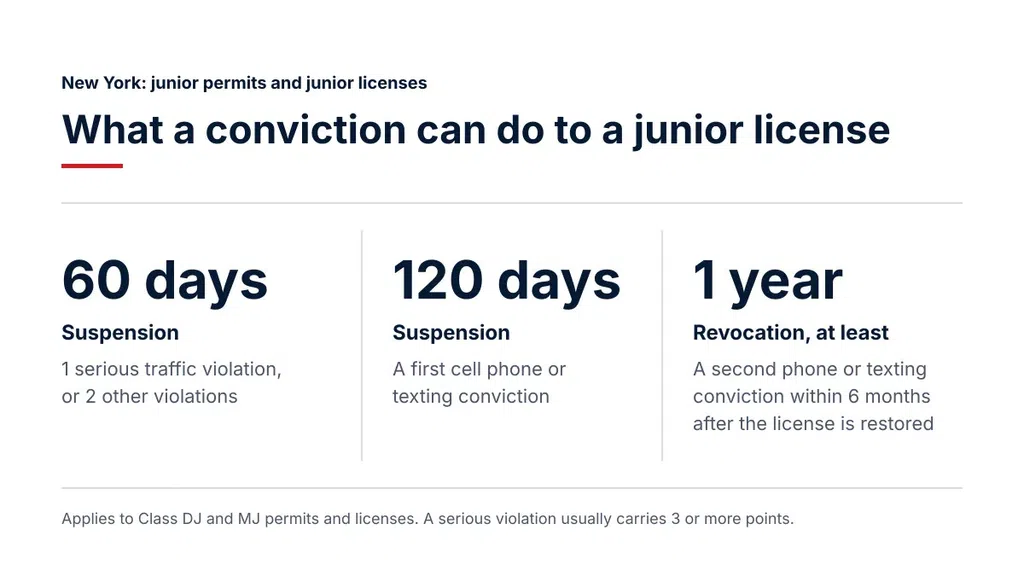
A ticket is an accusation, not a conviction. You are presumed innocent, and the state has to prove its case. But if a junior driver pleads guilty or is found guilty, New York law (VTL 510 and 510-c) sets these license penalties:
| If you're convicted of | What happens to the junior permit or license |
|---|---|
| One serious traffic violation, or two other traffic violations, committed while holding a Class DJ or MJ permit or license | Suspended for 60 days |
| One serious traffic violation, or two other traffic violations, committed within six months after restoration of a permit or license previously suspended under these rules | Revoked for 60 days |
| A first cell phone or texting violation committed while holding a Class DJ or MJ permit or license | Suspended for 120 days |
| A second cell phone or texting violation within six months after the permit or license is restored | Revoked for at least one year |
A suspension means your license is put on hold for a set time. A revocation means your license is canceled, and you must reapply for a new one.
What counts as a serious traffic violation?
The DMV says a serious traffic violation normally carries three or more points. The law itself gives a specific list. It includes reckless driving, running a red light or stop sign, passing a stopped school bus, speed contests, and many passing, lane, and right-of-way violations. Speeding counts as "serious" only when it involves going 10 or more miles per hour over the limit under the specific speeding-law subdivisions listed in VTL 510-c(2).
That detail matters a lot. A ticket for 9 mph over isn't a serious violation under this law, but it still counts as one of the "two other violations." If you have a speeding ticket, our page on speeding with a junior license covers more of what's at stake.
Fines and points for common tickets
The license penalties above come on top of the fines and points every driver faces. Here are some common tickets for a first offense, using the state's speeding fine ranges and the point values the DMV uses for violations on or after February 16, 2026.
| Ticket | Fine for a first offense | DMV points |
|---|---|---|
| Speeding up to 10 mph over | $45 to $150 | 3 |
| Speeding 11 to 20 mph over | $90 to $300 | 4 |
| Speeding 21 to 30 mph over | $90 to $300 | 6 |
| Speeding 31 to 40 mph over | $180 to $600 | 8 |
| Speeding more than 40 mph over | $180 to $600 | 11 |
| Cell phone or texting while driving | $50 to $200 | 5 |
| Violating a license restriction (VTL 509(3)) | $75 to $300, up to 15 days in jail, or both | 0 |
For most moving traffic infractions, including speeding and cell-phone violations, the mandatory surcharge and crime victim assistance fee total $60, and the additional surcharge is $28. That brings the total to $88. In a town or village court, an additional $5 brings the total to $93. Certain Article 9 traffic infractions have a lower surcharge. If you get 6 or more points in 18 months, the DMV adds a Driver Responsibility Assessment of $100 a year for three years, plus $25 a year for each point over 6. Like any driver, a junior driver who reaches 11 points within 24 months can also have their license suspended.
Don't plead guilty before you talk to a lawyer. Call 888-883-5529 for a free consultation.
We Want To Hear About Your Traffic Ticket
Get your FREE attorney consultation from Rosenblum Law.
Quick, free, and no obligation.
Cell phone and texting tickets for junior drivers
For a junior driver, a phone ticket brings a longer suspension than most other traffic tickets. New York bans holding a phone to talk (VTL 1225-c) and using a portable device to text, browse, or play games while driving (VTL 1225-d). For a junior driver, a guilty plea can bring:
- A 120-day suspension for a first conviction for a violation committed while holding a Class DJ or MJ permit or license. That's twice as long as the 60-day suspension for other violations.
- A revocation of at least one year for a second conviction within six months after the permit or license is restored.
- 5 points on the driving record, the same as for any driver.
- Fines of $50 to $200 for a first offense, $50 to $250 for a second offense within 18 months, and $50 to $450 for a third or later offense within 18 months, according to the DMV's cell phone and texting penalties. A surcharge is added to each.
A four-month suspension can affect getting to school, work, or a road test. Our page on New York cell phone tickets explains these charges in more detail. Before you pay a phone ticket, talk to a lawyer about whether the state can prove it.
How a lawyer can help with a junior license ticket
Maybe your teen knows they were going a little fast or picked up the phone. That doesn't mean they have to accept every point and penalty on the ticket. Everyone has the right to make the state prove its case.
What a lawyer can do depends on the court. Outside New York City, many local courts allow a deal to plead to a lesser charge, depending on the facts and the prosecutor. Most non-criminal moving violations issued in New York City are handled by the Traffic Violations Bureau (TVB), which doesn't allow plea bargaining. There, the focus is on the hearing itself.
Here are some things a lawyer can look at:
- Whether the speed evidence holds up. In People v. Olsen, 22 N.Y.2d 230 (1968), New York's highest court said an officer's visual estimate of speed can be used if the officer has experience judging speed. But the gap between the estimate and the limit must be "sufficiently wide" for the court to be sure beyond a reasonable doubt. In People v. Kogosov, 15 Misc. 3d 139(A) (App. Term 2007), a later court applied this rule and called a 20 mph gap "clearly sufficient." This means a small claimed difference is harder for the state to prove by estimate alone.
- Whether a device reading was backed up. In People v. Isler, 67 Misc. 3d 143(A) (App. Term, 2d Dept. 2020), an officer said a driver was going 85 mph in a 55 mph zone, based on his patrol car's speedometer while following the driver. He produced no calibration records and gave no visual estimate. The court ruled that wasn't enough to prove 85 mph and sent the case back for a new sentence based on 65 mph.
- Whether the restriction really applied. For a restriction ticket, the details matter. A lawyer can check the time, the region, where the driver was headed, any proof of work, and whether passengers were immediate family.
- Whether a lesser charge is possible. In courts that allow it, a deal to plead to a lesser charge may help avoid a "serious traffic violation" that triggers a suspension. This isn't available at the NYC TVB.
Every case is different, and a defense that worked in one case may not work in another. Before you plead guilty, find out what options you have in your court.
Special situations for junior drivers
Some tickets and charges bring extra consequences for young drivers. Here are a few to know about:
- Alcohol under New York's Zero Tolerance Law. A driver under 21 with a blood alcohol content (BAC), how much alcohol is in the blood, of at least .02 but not more than .07 may face an administrative DMV proceeding if the driver is not also charged under VTL 1192 for the same incident. A Zero Tolerance finding is not a criminal conviction. A first finding brings a six-month suspension, a $125 civil penalty, and a $100 suspension termination fee. A second finding brings a revocation of one year or until age 21, whichever is longer, a $125 civil penalty, and a $100 reapplication fee.
- Refusing a chemical test under 21. Under the DMV's civil penalty rules, a first refusal under the Zero Tolerance Law leads to a one-year revocation, a $500 civil penalty, and a $100 reapplication fee. A higher BAC or evidence of impairment may also lead to a separate DWAI or DWI charge under VTL 1192, which is handled in court.
- A ticket in New York City. Most non-criminal traffic violation tickets issued in New York City are handled by the TVB, which does not allow plea bargaining. Parking tickets, camera violations, and criminal traffic offenses are handled elsewhere. Since junior license holders can't drive in the city at all, a junior license ticket there may also include a license restriction charge.
- Motorcycle permits (Class MJ). The supervising driver must hold a valid motorcycle license, exercise general supervision, remain within one-quarter mile, and keep the rider in sight at all times. The supervisor is the only passenger allowed.
If any of these apply, the stakes are higher than a typical ticket. It's worth getting advice about your specific situation before your court date.
What to do after a junior license ticket
If your teen just got a ticket, a few early steps can help protect their options. Here's where to start:
- Don't plead guilty or pay yet. A conviction can bring a 60-day or 120-day suspension, plus points and fines.
- Note the court date. Write it down and plan for it, because missing court can cause new problems.
- Write down what happened. Include the time, place, where your teen was going, who was in the car, and anything the officer said.
- Gather proof. Keep the ticket, any MV-58A work certificate, school or program records, photos, and dashcam video.
- Call for a free consultation. We can go over the ticket and the driving record with you.
Taking these steps early can keep more choices open later.
FAQs
Can the judge decide not to suspend a junior license?
Not after a qualifying conviction. The law (VTL 510-c) says the permit or license "shall be suspended," which makes the suspension required. That's why the exact charge a junior driver is convicted of matters so much.
Can a defensive driving course stop a junior license suspension?
No. The DMV says its crash prevention course, often called defensive driving, can reduce up to four points and may lower insurance premiums by up to 10 percent. But it doesn't prevent a mandatory suspension or revocation.
Will a suspended permit push back my road test?
It can. You must hold your junior permit for at least six months before the road test, and time under suspension or revocation doesn't count. A 60-day suspension can add about two months to your wait.
Can I drive home alone from a late game or practice upstate?
Not after 9 p.m. without a supervisor. The nighttime "school course" exception covers instruction, education, or training licensed or approved by a state agency or department, as well as training conducted by the U.S. Armed Forces. Sports, clubs, and social events without scholastic credit don't count.
Can I drive in another state with my New York junior license?
Yes, if that state's laws allow it. You must follow that state's junior permit and license rules while you're there. Drivers who are 16 or 17 and hold an out-of-state learner permit, junior permit, or junior driver license must follow their home-state restrictions and the applicable New York restrictions when driving here.
Talk to a New York traffic attorney
A ticket on a junior permit or license can lead to a suspension much sooner than it would for most adult drivers. That's a lot for a young driver and their family to deal with. Still, the ticket is only the officer's accusation, not proof.
You have the right to make the state prove its case, and you don’t have to sort through your options alone. Before you plead guilty, find out where you stand. Rosenblum Law has handled over 100,000 traffic tickets.
Call 888-883-5529 for a free, no-obligation consultation.
Sources
- NY DMV, The Graduated License Law and Restrictions for Drivers Under 18 (regional junior permit and license restrictions, penalties, out-of-state junior license rules, and senior license eligibility)
- NY DMV, Learner Permit Restrictions (permit supervision, passenger limits, prohibited roads, motorcycle supervision, and out-of-state permit requirements)
- NY DMV, Plead To or Pay New York City (NYC) 'TVB' Traffic Tickets (TVB jurisdiction and hearing procedures)
- NY DMV, Cell Phone Use and Texting (fines, points, and junior-driver suspension penalties)
- NY DMV, Pay a Driver Civil Penalty (Zero Tolerance and chemical-test-refusal penalties)
- NY DMV, Driver Responsibility Assessment (assessment thresholds and amounts)
- NY DMV, Chapter 2: How to Keep Your License (point system and defensive driving courses)
- NY DMV, 2026 Point System Memorandum (2026 point changes and 24-month look-back period)
- NY Governor's Traffic Safety Committee, Penalties for Speeding (speeding fine ranges)
- NY Senate, VTL 1180 (speeding violations)
- NY Senate, VTL 1192-a (Zero Tolerance Law)
- NY Senate, VTL 1194-a (Zero Tolerance hearings and chemical-test refusals)
- NY Senate, VTL 1809 (mandatory surcharge and crime victim assistance fee)
- NY Senate, VTL 1809-e (additional surcharge)
- NY Senate, VTL 501-b (additional restrictions on junior permits and licenses)
- NY Senate, VTL 509 (license violations and penalties)
- NY Senate, VTL 510 (suspension and revocation of licenses)
- NY Senate, VTL 510-c (suspension and revocation of junior permits and licenses)
- NY Senate, VTL 1225-c (use of mobile telephones)
- NY Senate, VTL 1225-d (use of portable electronic devices)
- People v. Kogosov, 15 Misc. 3d 139(A), 2007 NY Slip Op 50944(U) (App. Term, 9th & 10th Jud. Dists. 2007), official court opinion (visual speed estimates and People v. Olsen)
- People v. Isler, 67 Misc. 3d 143(A), 2020 NY Slip Op 50746(U) (App. Term, 2d Dept. 2020), official court opinion (patrol-car speedometer evidence)