
Getting a speeding ticket in New York is stressful, and you may be wondering if it could land you in jail. The honest answer is that New York law does allow jail for some speeding tickets, but in my experience it is not the usual outcome.
This page explains exactly when jail is possible, what a guilty plea really costs, and why you should talk to a lawyer before you plead guilty. A ticket is an accusation, not a conviction. You have the right to make the state prove its case.
Is speeding a crime in New York?
No. A basic speeding ticket is a traffic infraction, not a crime. New York law says a traffic infraction is not a crime and its punishment is not a criminal punishment (VTL 155). But "not a crime" does not mean "no jail." The speeding law itself allows a judge to order jail time in some cases (VTL 1180). Whether jail is possible depends on how fast the ticket says you were going, where it happened, and your recent record.
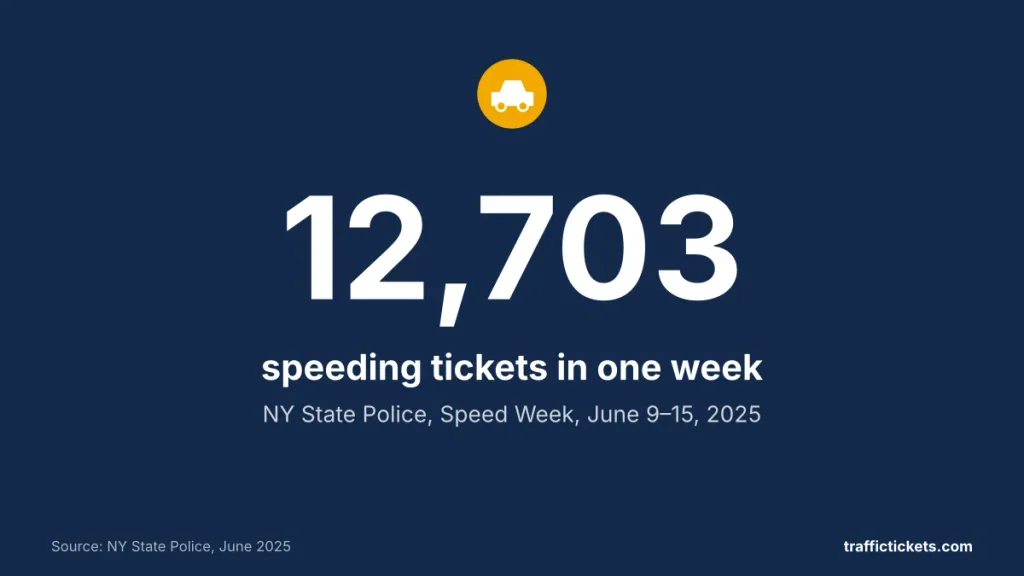
Some speed-related charges are more serious. These charges are misdemeanors, which are crimes:
- Reckless driving (VTL 1212)
- Speed contests or racing (VTL 1182)
- Driving while your license is suspended (VTL 511)
If your ticket lists one of these, the stakes are higher, and I explain each one below. If it is a regular New York speeding ticket, the next section shows the exact jail limits the law sets.
How much jail time does New York allow for speeding?
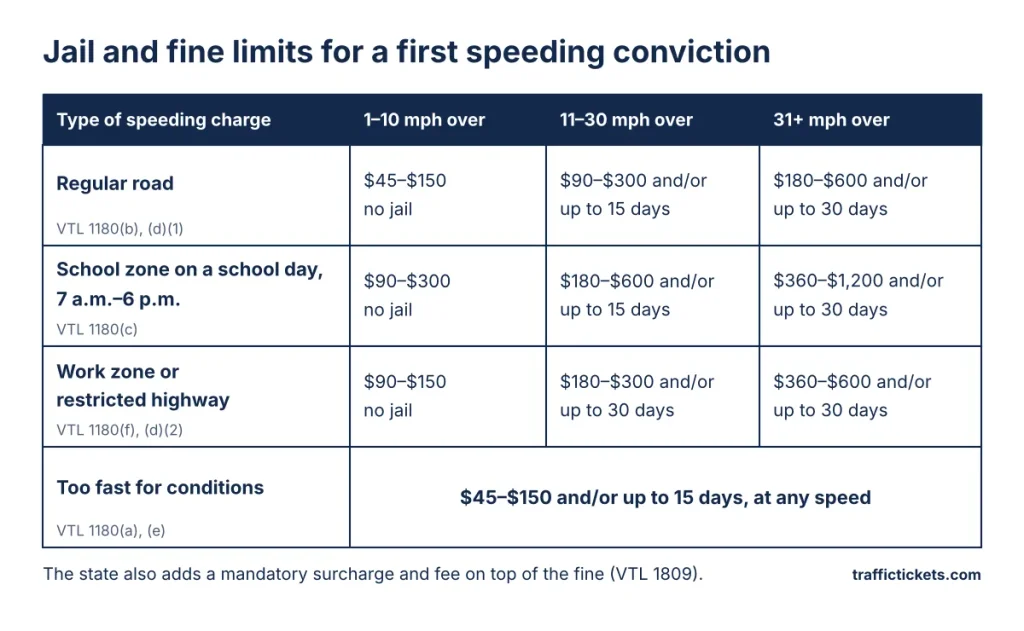
For a first speeding ticket, the most jail New York allows is 15 or 30 days. Many tickets carry no jail at all. The limit depends on how far over the speed limit the court finds you were going (VTL 1180(h)). These are upper limits, not set sentences. The judge decides, and the judge can choose a fine instead of jail. The law allows a fine, jail, or both in the higher speed ranges.
School zones and work zones
School and work zones have their own penalty rules. In a school zone, the fines are higher. In a work zone, the 30-day jail limit starts at 11 mph over instead of 31.
"Too fast for conditions" tickets
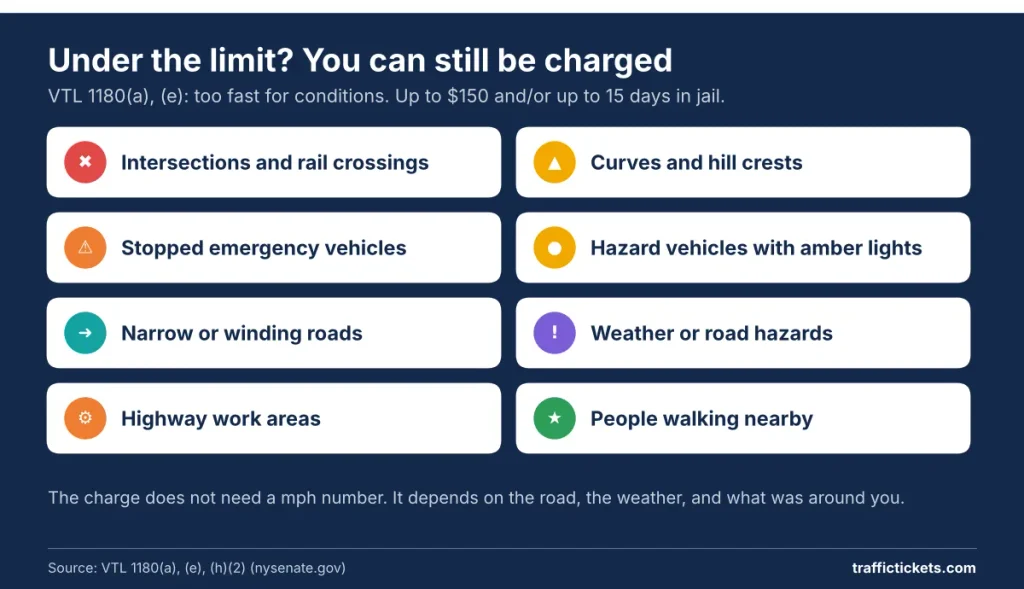
You can get a speeding ticket even if you were under the posted limit. The law says you must drive at a speed that is safe for the conditions (VTL 1180(a), (e)). The law names places where you must slow down, including:
- Intersections and railroad crossings
- Curves and hill crests
- Stopped emergency vehicles and hazard vehicles with flashing lights
- Narrow or winding roads
- Bad weather, road hazards, and highway work areas
This charge carries up to 15 days in jail on a first conviction, no matter the speed. It also depends on judgment calls about the road that a lawyer can look at closely. But these numbers only matter if you are found guilty or plead guilty. Before you pay this ticket, talk to a lawyer about whether the state can prove the speed it claims.
Does a second or third speeding ticket mean jail?
Not automatically, but the limits go up. If you are convicted of a second speeding violation within 18 months, the law allows up to 30 days in jail (VTL 1180(h)(5)). That limit applies even to tickets for 1–10 mph over.
The 18 months are counted from the dates of the violations, not the court dates. Here is what changes with each repeat conviction:
- Second violation within 18 months: the highest possible fine goes up by $150, and up to 30 days in jail is allowed.
- Third violation within 18 months: the highest possible fine goes up by $375, and up to 30 days in jail is allowed.
- Third speeding conviction within 18 months: the DMV must revoke your license for at least six months. That means your license is canceled, and you must reapply for a new one (NY DMV Driver's Manual, Chapter 2).
If you already have a speeding ticket from the last 18 months, a new one deserves extra care. A lawyer can check the dates and look for options that keep you out of the repeat-offense range.
When can a speeding stop turn into a criminal charge?
A speeding stop can lead to a criminal charge when the police allege more than speed. The three charges I see most with speed are reckless driving, a speed contest, and driving while suspended. Each one is a misdemeanor, which means a conviction can leave you with a criminal record.
Reckless driving
Reckless driving means driving in a way that unreasonably interferes with the use of the road or unreasonably endangers others (VTL 1212). Since November 22, 2024, the law also covers many parking lots (NY DMV notice to courts). The penalties grow with each conviction for violations within 18 months (VTL 1801):
- First conviction: up to 30 days in jail, a fine of $100 to $300, or both
- Second within 18 months: up to 90 days in jail, a fine up to $525, or both
- Third within 18 months: up to 180 days in jail, a fine up to $1,125, or both
Reckless driving also carries 5 DMV points. You can read more on my reckless driving charge page.
Speed contests and racing
A speed contest charge says you raced or took part in an exhibition of speed on a public road (VTL 1182). This charge carries some of the heaviest penalties tied to speed:
- First conviction: up to 30 days in jail, a fine of $300 to $525, or both
- Second conviction within 12 months: up to six months in jail, a fine of $525 to $750, or both
- License: revoked for at least six months, or at least one year for a second conviction within 12 months (NY DMV Driver's Manual, Chapter 2)
- Points: 5 DMV points for violations on or after February 16, 2026
The good news is that the state has to prove an actual race, not just fast driving. Two cars speeding near each other is not enough on its own. A lawyer can look at whether the police have facts showing an agreement to race or a planned course.
Driving while suspended
This is the charge that catches many people by surprise. If you don't answer a ticket on time, the DMV can suspend your license. Driving on a suspended license is a crime (NY DMV).
The basic charge, aggravated unlicensed operation in the third degree, allows up to 30 days in jail (VTL 511). It also now carries 11 DMV points. To lift a suspension for not answering, you must answer the ticket and pay a $70 suspension termination fee. Learn more about missing a traffic court date.
If your ticket lists any of these charges, please don't handle it alone. Call 888-883-5529 for a free consultation before your first court date.
What happens if I plead guilty to speeding?
For most people, the real cost of a guilty plea is not jail. It is the points, DMV fees, and license risk that follow you for years. A guilty plea counts as a conviction, and the conviction sets each of these in motion.
How points can cost you your license
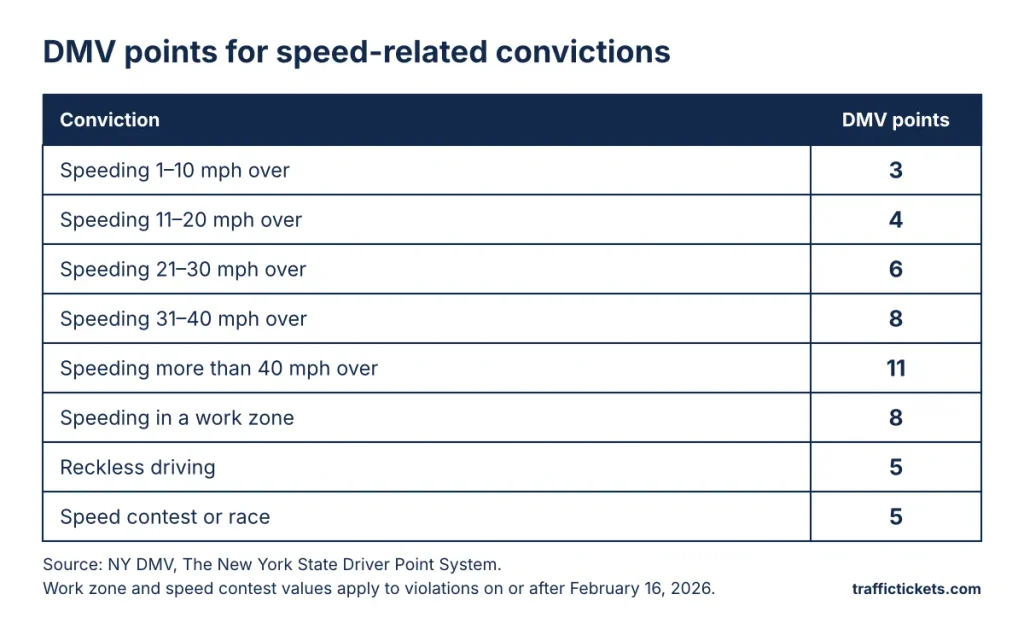
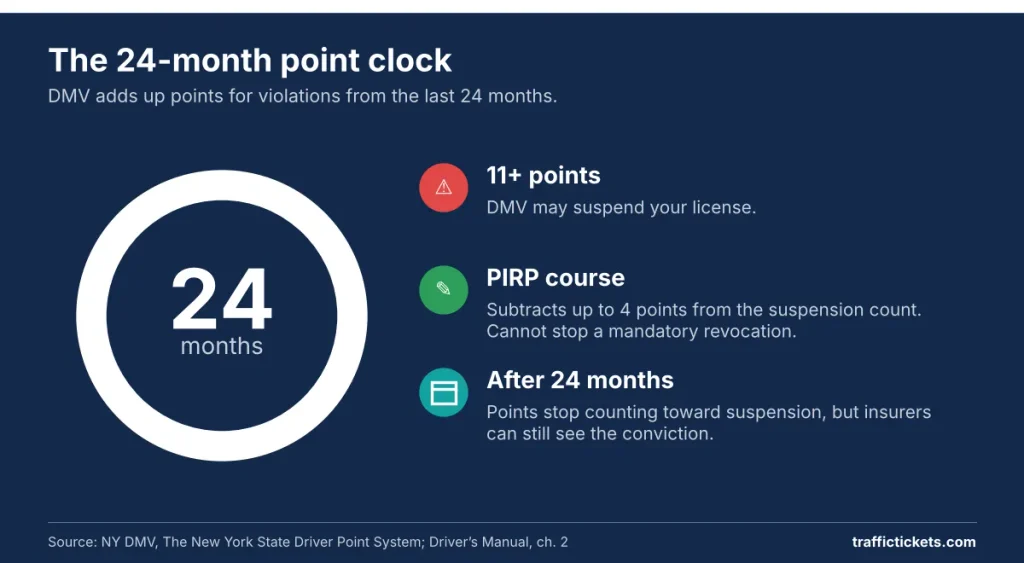
The DMV may suspend your license if you get 11 points in 24 months. A suspension means your license is put on hold for a set time. Think of each ticket as starting its own 24-month timer from the violation date. Here are the key rules:
- Points count from the date of the violation, not the date of conviction.
- A DMV-approved Point and Insurance Reduction Program (PIRP) course can subtract up to 4 points from the suspension count.
- A PIRP course cannot stop a mandatory revocation, like the one for three speeding convictions in 18 months.
- After 24 months, the points stop counting toward suspension, but the conviction stays on your record. Insurers can still use it.
One ticket for more than 40 mph over equals 11 points by itself. That is why the speed written on the ticket matters so much.
The Driver Responsibility Assessment
The Driver Responsibility Assessment (DRA) is a separate DMV fee, paid over three years. It applies if you get 6 or more points in 18 months (NY DMV). It costs $300 for 6 points, plus $75 for each point over 6. A PIRP course does not reduce it.
Insurance and your record
Insurance companies use their own point systems and can raise your premiums based on your driving record, according to the DMV. A speeding conviction is not a criminal conviction. Reckless driving, speed contests, and driving while suspended are misdemeanors, so those can create a criminal record.
What are my rights after a speeding ticket?
You are presumed innocent. A ticket is the officer's accusation, not proof. The state still has to prove every part of the charge, including the speed it claims.
Every driver who gets a ticket in New York can present a defense and be represented by a lawyer (NY DMV Driver's Manual, Chapter 2). How your case runs depends on where the ticket was written.
NYC tickets vs. tickets everywhere else
Moving violations in the five boroughs of New York City go to the DMV's Traffic Violations Bureau (TVB). Most tickets outside the city go to a local town, village, or city court. The two systems work very differently:
- NYC TVB: a DMV hearing officer decides the case. The TVB cannot order jail for a traffic infraction (VTL 227). The state must prove the charge by clear and convincing evidence. Deals to plead to a lesser charge are not allowed.
- Local courts: a judge decides the case and can order jail where the law allows it. The proof needed is beyond a reasonable doubt. A deal to plead to a lesser charge may be possible, depending on the court and the prosecutor.
- Criminal charges: reckless driving, speed contests, and driving while suspended are crimes, so they go to criminal court, even in New York City.
So if your only charge is a speeding ticket at the NYC TVB, jail is not on the table. Points, fines, and license risk still are. Maybe you know you were going a little fast. That doesn't mean you have to accept every point and penalty on the ticket. Everyone has the right to make the state prove its case. Before you plead guilty, talk to a lawyer.

Talk To Us About Your Speeding Ticket
Call Today - We've Fought Over 100,000 Traffic Violations
Quick, free, and no obligation.
How can a lawyer help with a speeding charge?
A lawyer can test the state's evidence, check the ticket and the stop for mistakes, and look for ways to lower the charge or the penalties. With speeding, the most important piece of evidence is usually the speed itself. That number sets the fine, the points, and the jail limit.
The recorded speed decides the jail limit
When someone is convicted of speeding, the court records the speed the conviction is based on (VTL 1180(h)). One mph can move a case into a higher bracket. At 30 mph over, the jail limit on a regular road is 15 days. At 31 mph over, it is 30 days.
Defenses a lawyer may look at
Every case is different, and a defense that worked once may not work in yours. Here is what I look at when I review a speeding ticket:
- Radar or laser accuracy. The officer may need to show the device was working correctly. If the records are missing or weak, I can challenge the reading.
- The officer's visual estimate. The officer must have training or experience in judging speed. The estimate must also be far enough over the limit to be reliable.
- The officer's view. I look at distance, traffic, weather, and how long the officer saw your car.
- The ticket itself. Errors in the paperwork or the charge may matter, depending on the court.
- The conditions charge. For a "too fast for conditions" ticket, the state must show your speed was unsafe for that road at that moment.
These checks can matter even if a ticket can't be dismissed. Showing a lower speed can mean fewer points and a lower jail limit.
How courts judge speed evidence
In People v. Olsen, 22 N.Y.2d 230 (1968), New York's highest court looked at whether an officer's estimate alone could prove speeding. The officers estimated 50 to 55 mph in a 30 mph zone. The court said that was enough, because the gap was wide and the officers were trained.
The court also said an estimate of 35 or 40 mph in that same zone might not be enough without a device to back it up. This means a small gap between the estimate and the limit is a weak spot in the state's case. I look closely at that gap in every estimate case.
Speed alone is usually not reckless driving
In People v. Grogan, 260 N.Y. 138 (1932), New York's highest court reversed a reckless driving conviction. The court said reckless driving takes more than negligence, and speed alone is not enough. The driving must show "a reckless disregard of the consequences." In plain words, the state must show dangerous conduct beyond just going fast.
This means a reckless driving charge built mostly on speed may be open to challenge. A lawyer can look at what else the police say happened.
An attorney must review your specific facts. But these cases show that courts take the state's burden of proof seriously, and so should you before you plead.
Are the rules different for new, young, or out-of-state drivers?
Yes. Some drivers face DMV penalties on top of anything the court orders. These rules come from the NY DMV Driver's Manual, Chapter 2:
- Junior permit or license: a conviction worth 3 or more points means a 60-day suspension. Every speeding conviction is worth at least 3 points.
- New driver on probation: if you are 18 or older, your first six months with a license are a probation period. A speeding conviction during that time means a 60-day suspension.
- Second probation period: after that suspension, another speeding conviction during the new probation means a revocation of at least six months.
- Repeat convictions: three speeding or misdemeanor traffic convictions within 18 months mean a revocation of at least six months.
If you hold a commercial driver license (CDL) or a TLC license, a speeding conviction can also affect your job. Those rules are complex, so please call us before you plead so we can review your situation.
What should I do next?
You don't have to figure this out alone, and you don't have to decide today. Taking these steps now protects your options:
- Don't pay the ticket yet. Paying the fine can count as pleading guilty, so talk to a lawyer first.
- Answer the ticket on time. Read the back of the ticket for your deadline. Missing it can lead to a suspended license.
- Note your court date and court name. Is it the NYC TVB or a local court? The answer changes your options.
- Check the speed and the charge. Look for the mph written on the ticket and the law section listed, such as VTL 1180(b) or 1212.
- Write down what happened. Note the weather, traffic, road signs, and where the officer was. Save photos if you have them.
- Gather your record. List any tickets from the last 18 to 24 months. Repeat tickets change the stakes.
- Call for a free consultation. Our intake team can explain your options before your court date.
These steps take a little time, but they can protect your license and your wallet. Find out your options before your court date. Call or text 888-883-5529.
FAQ
Can the police arrest me for speeding in New York?
They have the legal power to. For arrests without a warrant, New York law treats a traffic infraction as an "offense" (VTL 155). In my experience, though, most speeding stops end with a ticket, not an arrest.
Will a speeding conviction hurt me if I have to testify in court?
No. New York law says a traffic infraction conviction does not affect your credibility as a witness (VTL 155). It does go on your DMV driving record, which is separate from a criminal record.
Do out-of-state speeding tickets count against my New York license?
Usually not for points. The DMV does not add points for convictions in other states, but Canadian convictions do count. If you don't answer a moving ticket from most other states, New York can still suspend your license until you do (NY DMV Driver's Manual, Chapter 2).
What if I can't afford to pay the fine?
You have options. New York changed the law so most traffic tickets no longer lead to a license suspension for failure to pay, and payment plans are available (NY DMV). A suspension for failing to appear in court is different, so don't skip your court date.
Talk to a NY traffic ticket lawyer
Jail for speeding in New York is possible, but it’s only one part of the picture. A guilty plea can also result in points, DMV fees, and license loss that follow you for years. The ticket itself, though, is only the officer’s accusation, not proof that you were speeding.
You have the right to make the state prove its case, so let’s talk about how. Rosenblum Law is the highest customer-rated traffic defense law firm in New York. Call 888-883-5529 for a free consultation.
Sources
Laws
- NY Vehicle and Traffic Law § 155, Traffic infraction
- NY Vehicle and Traffic Law § 227, Hearings; determinations
- NY Vehicle and Traffic Law § 511, Aggravated unlicensed operation
- NY Vehicle and Traffic Law § 1180, Basic rule and maximum limits
- NY Vehicle and Traffic Law § 1182, Speed contests and races
- NY Vehicle and Traffic Law § 1212, Reckless driving
- NY Vehicle and Traffic Law § 1801, Penalties for misdemeanors
- NY Vehicle and Traffic Law § 1809, Mandatory surcharge
Agencies
- NY DMV, The New York State Driver Point System
- NY DMV, Driver Responsibility Assessment
- NY DMV, Driver's Manual, Chapter 2: How to Keep Your License
- NY DMV, Tickets Received Outside New York City
- NY DMV, Traffic Ticket Payment Plans
- NY DMV, Notice to courts on Chapter 436 of the Laws of 2024 (reckless driving in parking lots)
- NY State Police, Speed Week results (June 2025)
Court decisions