
If you drive a commercial vehicle, a few extra rules apply to a New Jersey traffic ticket. Federal and state law tie certain convictions to your commercial driver’s license (CDL). That can include a ticket you get in your personal car, not just one you get while driving for work.
Knowing how those rules work before your court date lets you make an informed choice. On this page, I'll explain which tickets can lead to a CDL disqualification, what a conviction sets in motion, and what your options are. Before you plead guilty, talk to a lawyer about how this charge fits with your driving record.
Vehicles that require a CDL in New Jersey
New Jersey sorts commercial licenses into three classes based on a vehicle's weight rating, its cargo, and its seating. The class printed on your license controls which of these vehicles you may drive.
| Class | Vehicles it covers |
|---|---|
| A | Any vehicle with a gross combination weight rating (GCWR), the combined rating of a truck and what it tows, of 26,001 pounds or more |
| B | Any vehicle with a gross vehicle weight rating (GVWR), the maker's maximum loaded weight, of 26,001 pounds or more |
| C | Vehicles that carry placarded hazardous materials, are designed for 16 or more people including the driver, or are used for hire and designed for 8 to 15 people including the driver |
A higher class can cover vehicles in a lower class once you hold the needed endorsements. Your class doesn't change how tickets count, though. A Class C bus driver and a Class A tractor-trailer driver face the same disqualification rules.
Pleading guilty to a traffic ticket with a CDL
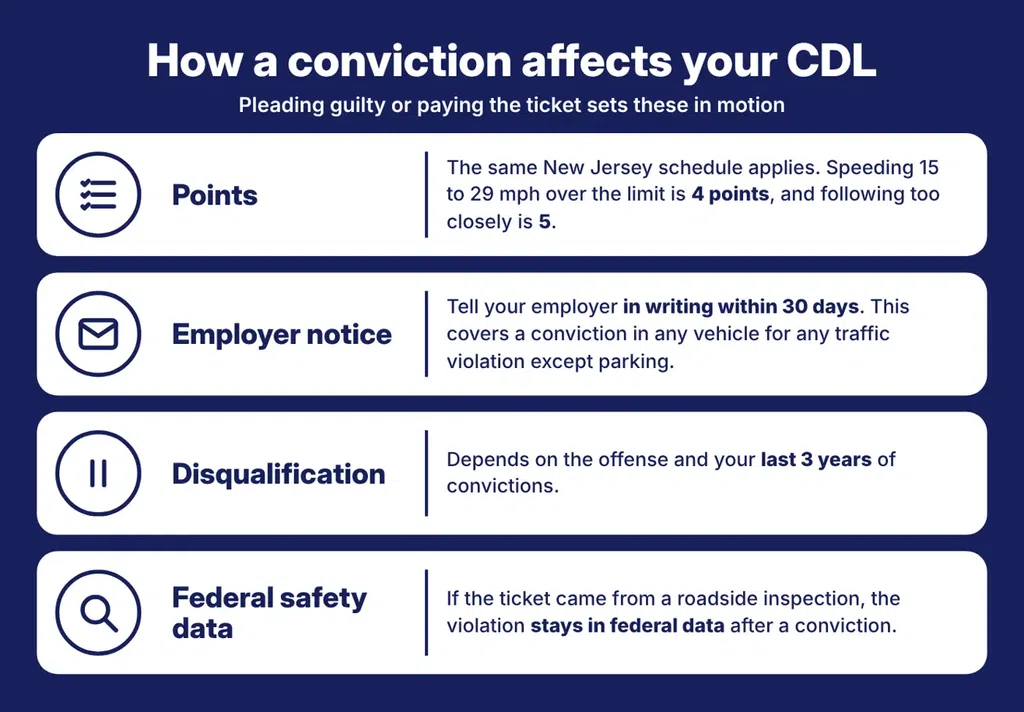
A guilty plea is a conviction, and for a CDL holder a conviction sets off duties that other drivers don't have. Some come from New Jersey law, and others come from federal rules that apply in every state.
Paying the ticket counts as a conviction
Federal CDL rules define a conviction to include paying a fine (49 CFR 383.5). Paying the ticket closes the case the same way a guilty plea does. Each effect runs on its own track. So one ticket can reach your license, your employer, and your federal records at once. Resolving one of them, such as paying the fine, doesn't resolve the others.
Some tickets can lead to a CDL disqualification
A disqualification bars you from driving a commercial vehicle for a set period. It doesn't, by itself, stop you from driving your own car. Federal law sets the minimum periods, and every state, including New Jersey, must apply them (49 CFR 383.51).
Two-strike violations
These violations don't disqualify you on a first conviction. They count once you have more than one, from separate incidents, within 3 years, and they don't have to be the same type. A speeding ticket and a tailgating ticket add up the same way two speeding tickets do:
- Speeding 15 mph or more over the limit
- Reckless driving
- Improper or erratic lane changes
- Following too closely
- Texting or using a hand-held phone while driving a commercial vehicle
- Driving a commercial vehicle without a CDL, without it in your possession, or without the proper class or endorsement
Two convictions within 3 years bring a 60-day disqualification, and a third brings 120 days. A conviction in your own car counts only if it leads to a suspension, revocation, or cancellation of your license. Careless driving is not on the list.
One-strike offenses
Major offenses can disqualify you after a single conviction. Most apply whether you were in a commercial vehicle or your own car. The periods below are the federal minimums, except where a row is marked as New Jersey law.
| Offense | First conviction | Second conviction |
|---|---|---|
| Driving under the influence of alcohol or drugs, in any vehicle | 1 year | Life |
| Blood alcohol content (BAC), the amount of alcohol in your blood, of 0.04% or more in a commercial vehicle | 1 year | Life |
| Refusing an alcohol test | 1 year | Life |
| Leaving the scene of a crash | 1 year | Life |
| Using a vehicle to commit a felony, other than the two felonies in the next rows | 1 year | Life |
| Using any vehicle to commit a felony involving making, selling, or giving out controlled substances | Life, with no option to reinstate after 10 years | Already lifetime |
| Using a commercial vehicle to commit a felony involving a severe form of human trafficking | Life, with no option to reinstate after 10 years | Already lifetime |
| Driving a commercial vehicle while your CDL is suspended, revoked, or disqualified because of earlier violations in a commercial vehicle | 1 year | Life |
| Causing a death by negligent operation of a commercial vehicle | 1 year | Life |
| New Jersey law: a traffic violation, other than parking, connected to a fatal crash, in any vehicle | 1 to 3 years | Life |
A first-offense period rises to 3 years if you were hauling placarded hazardous materials. A state may lift a lifetime disqualification after 10 years if you finish an approved rehabilitation program. That option doesn't exist for the drug and human trafficking felonies in the table above.
New Jersey law goes further than the federal rules on those two felonies. The MVC must revoke your CDL privilege for life for a drug-distribution crime committed with any vehicle. It must also do so after any human trafficking conviction, whether or not a vehicle was involved. Neither revocation can be shortened (N.J.S.A. 39:3-10.20(e)).
Railroad crossings and out-of-service orders
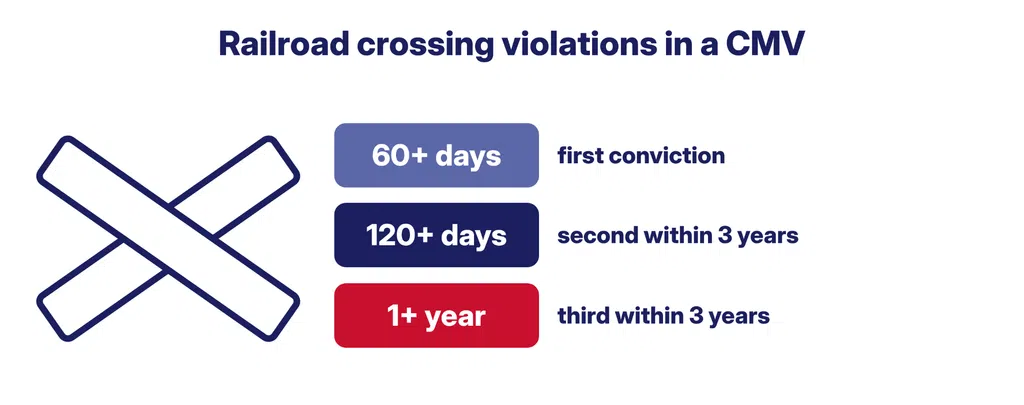
Two other groups carry their own periods. A first railroad crossing violation in a commercial vehicle brings at least 60 days. A second within 3 years brings at least 120 days, and a third brings at least 1 year. Driving in violation of an out-of-service order brings at least 180 days on a first conviction.
Where a ticket falls in these groups shapes what it can do to your CDL. The same charge that leaves your license untouched today can trigger a disqualification after the next one. That's why your full 3-year record matters as much as the newest ticket.
Your rights after a CDL traffic ticket
You are presumed innocent, and the State must prove each part of the charge. The ticket is the officer's claim, and the State has to back it with evidence in court. Holding a CDL doesn't lower that burden or change what the offense means.
You also have the right to see the evidence. New Jersey's court rules let you ask the prosecutor in writing for police reports, photos, video, and witness names (R. 7:7-7). In State v. Stein, 225 N.J. 582 (2016), the Supreme Court of New Jersey confirmed that this broad right applies in municipal court.
Maybe you know you were over the limit. That doesn't mean you have to accept every consequence the ticket carries. A plea is a choice, and you're entitled to know every option before you make it.

Fight Your CDL NJ Traffic Ticket.
Get Your FREE Consultation.
Call Us - We've Fought Over 100,000 Traffic Violations
Quick, free, and no obligation.
How a lawyer can help with a CDL ticket
With a CDL, the stakes reach beyond one court date. A lawyer looks at the charge, your 3-year history, and your federal safety data together. Depending on the facts, a lawyer can:
- Map the charge against the disqualification lists. One more serious violation can matter far more for some drivers than for others.
- Test the State's evidence. In State v. Wenzel, 113 N.J. Super. 215 (App. Div. 1971), an appeals court reversed a truck driver's careless driving conviction. A jackknife crash alone didn't prove the charge.
- Ask about a lesser charge. In municipal court, the judge must approve any deal. Federal rules also bar states from hiding a CDL holder's conviction through deferral or diversion programs (49 CFR 384.226).
- Explain how to clean up federal data. After a not-guilty finding or a dismissal without a fine or court costs, you can ask FMCSA to remove the related inspection violation through its DataQs system.
No lawyer can promise a specific result. A defense that worked in one case may not work in yours. What I can do is lay out your options before you make a choice that follows your license. Even when the charge stays the same, knowing the deadlines and records ahead of time lets you plan for them.
If your license is from another state or you have a CLP
A few situations change how a ticket follows a commercial driver. Each one adds a rule on top of those above:
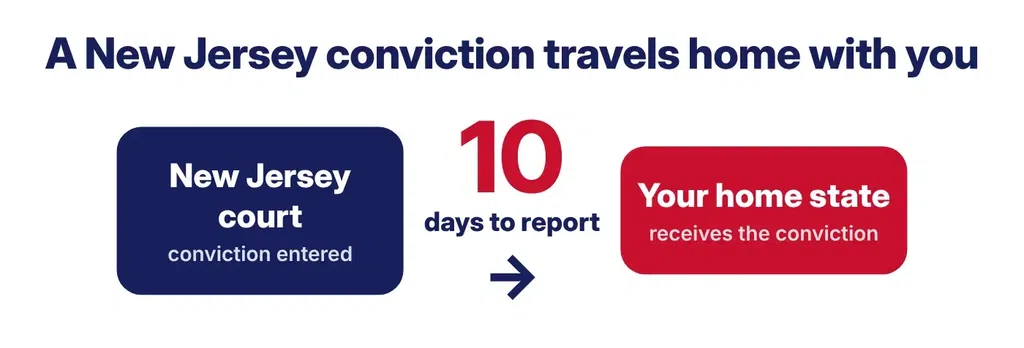
- Your CDL is from another state. New Jersey must report your conviction to your home state within 10 days (49 CFR 384.209).
- Your New Jersey CDL was ticketed in another state. New Jersey assigns 2 points for an out-of-state moving violation (N.J.S.A. 39:5D-4).
- You hold a commercial learner's permit (CLP). The MVC says CLP holders get the same enhanced penalties as CDL holders for all moving violations (NJ MVC, Commercial Learner Permits), including tickets in your personal car (NJ MVC, CDL FAQ).
- You had a DUI in your own car. The MVC lists a one-year CDL suspension for a first DUI in a passenger vehicle. A second brings a permanent revocation (NJ MVC**, CDL Violations**), though the MVC accepts applications to reinstate a lifetime CDL suspension. After a DUI, you can get a CDL once your suspension ends. But you can't keep or apply for a Passenger (P) endorsement for 3 years (NJ MVC, CDL FAQ).
When more than one of these applies, the rules stack. Bring your license or permit and any MVC notices to your consultation so each rule can be checked against your record. The MVC's CDL Unit also answers licensing questions at (609) 292-5151.
What you should do next
You have time to prepare before your court date. These four tasks show where your CDL stands, and none of them locks you into a plea:
- Hold off on paying the ticket.
- Gather any tickets or convictions from the last 3 years, if you have them.
- Get your driver history abstract from the MVC.
- Call 888-883-5529 for a free consultation.
Your employer or the MVC may mail you letters while the case is open, so save those as well. They tell us which deadlines have started and how this ticket lines up with your earlier ones.
FAQs
Can I keep driving a commercial vehicle while my ticket is pending?
Generally, yes. The federal disqualification periods apply to drivers who are convicted, not to drivers who have only been ticketed (49 CFR 383.51). A separate suspension or out-of-service order can still stop you from driving, so read every notice you receive.
Can I get a hardship or work license to keep driving commercially?
No. According to the FMCSA, a state may not knowingly issue a conditional, occupational, or hardship license that lets you drive a commercial vehicle while your regular driving privilege is disqualified. A work license some states offer for a personal car doesn’t extend to a truck or bus.
How fast should I tell my employer about a suspension?
By the end of the next business day. If your license is suspended, revoked, or canceled, or if you’re disqualified from commercial driving, you must notify your current employer before the end of the business day after you receive the notice (49 CFR 383.33). That deadline is much shorter than the 30 days you have to report a conviction.
Will a defensive driving course help with my points?
It may lower your point total. The MVC’s defensive driving program removes up to 2 points, once every 5 years, and only if you have points when you finish the course. The MVC describes it as a point reduction only, so don’t count on it to change how a conviction counts toward your CDL.
Can points lead to MVC surcharges?
Yes. If you collect 6 or more points within 3 years, the MVC charges a surcharge of $150 plus $25 for each point over 6, and it can bill you every year for 3 years. For example, two 4-point speeding tickets total 8 points, which means a surcharge of $200 a year.
Are there surcharges that don’t depend on points?
Yes. Certain convictions carry their own yearly surcharge for 3 years, no matter how many points you have. A first or second DWI conviction and a refusal to take a breath test each carry $1,000 a year, and driving with a suspended license carries $250 a year.
Talk to a CDL traffic ticket attorney
Your CDL took extensive training to earn. You have the right to make the State prove its case. A short conversation with the Rosenblum Law team can show you where you stand before your court date. We have handled 100,000+ traffic tickets and are ready to review yours.
Call 888-883-5529 for a consultation. It's free, and there's no obligation.
Sources
- NJ MVC, Commercial Driver License (CDL)
- NJ MVC, CDL Violations
- NJ MVC, CDL FAQ
- NJ MVC, Points Schedule
- NJ MVC, Online Services (driver history abstract)
- 49 CFR 383.5, Definitions
- 49 CFR 383.31, Notification of convictions
- 49 CFR 383.51, Disqualification of drivers
- 49 CFR 384.209, Notification of traffic violations
- 49 CFR 384.226, Prohibition on masking convictions
- FMCSA, Changes to reporting adjudicated citations (June 9, 2014)
- FMCSA, Adjudicated Citations fact sheet
- NJ Courts, Your Day in Court
- State v. Stein, 225 N.J. 582 (2016)
- State v. Wenzel, 113 N.J. Super. 215 (App. Div. 1971)
- 49 CFR 384.210 and FMCSA guidance on hardship licenses
- 49 CFR 383.33, Notification of driver's license suspensions
- NJ MVC, Surcharges
- NJ MVC, Commercial Learner Permits (CLP)
- NJ MVC, Suspensions and Restorations (point reductions, out-of-state points)
- N.J.S.A. 39:3-10.20, as amended by P.L.2022, c.11 (approved May 9, 2022)
- FMCSA, Lifetime Disqualification for Human Trafficking, 84 FR 35335 (July 23, 2019)